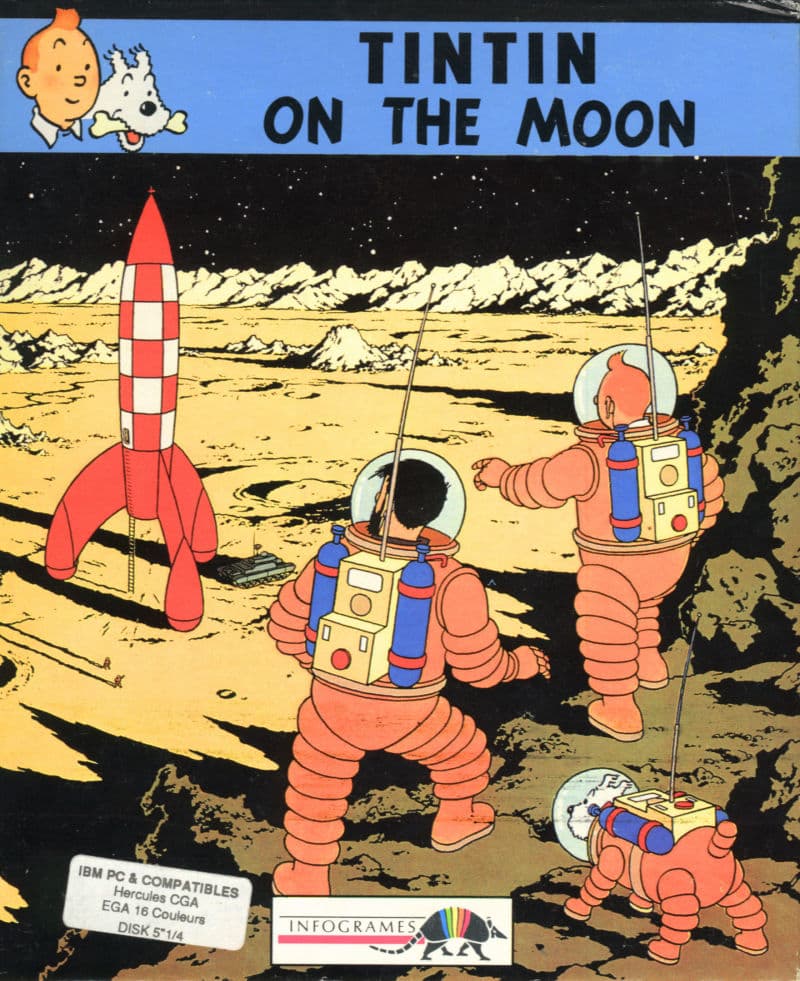
Tintin on the Moon
aka Tintin Sur La Lune · Tintin En La Luna · Tim Und Struppi Auf Dem Mond · Tim & Struppi auf dem Mond
Rate this game
- Played
- Rarely
If you played Tintin on the Moon back in 1989, you probably spent most of your time cursing an endless field of floating rocks before ever seeing the inside of the Syldavian rocket.
Probe Entertainment tried to package two entirely different games into one cartridge
Before comic book adaptations had standard templates, Infogrames handed the conversion duties for the red-and-white moon expedition off to Probe Entertainment. The original design by Philippe Nottoli and Henri Sérna set out to mirror Hergé's duo of comic albums, Destination Moon and Explorers on the Moon, with strict oversight from Studios Hergé ensuring total story fidelity. Programmers Daniel Charpy and Philippe Nottoli adapted the game for the PC, but the core design remained a jarring hybrid of flight simulation and interior platforming.
The space flight levels use a 2D scrolling, behind-the-rocket perspective where you dodge incoming meteorites. To progress through these six flight sequences, you must collect eight red spheres scattered across the path while snatching yellow spheres to keep your fuel and energy reserves high. It feels punishingly strict, especially on original hardware, because missing a cluster of yellow spheres early on guarantees a slow death by attrition long before the moon comes into view.
Interior sabotage makes Tintin on the Moon a race against time
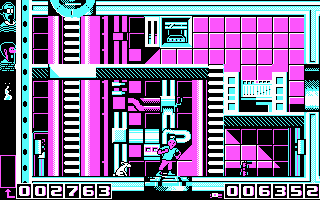
Once you survive an asteroid section, the game flips to a side-view, fixed flip-screen layout inside the rocket. This is where the actual narrative plays out over five distinct platforming levels. Colonel Boris, also known as Colonel Jorgen, is loose on the ship, planting time-bombs, igniting random fires, and leaving Captain Haddock and Professor Calculus tied up in various compartments.
As Tintin, armed only with a fire extinguisher, you have to clean up the mess room by room. The fire extinguisher serves a dual purpose: putting out randomly spawning flames and repeatedly blasting Colonel Jorgen into submission so you can capture him. You disarm bombs and free Haddock or Calculus simply by walking up and touching them. The sharpest mechanic in these sections is the anti-gravity toggle, which lets Tintin turn off ship gravity to float up to high ledges and reach bombs planted near the ceiling.
The flaws in this 1989 MS-DOS port
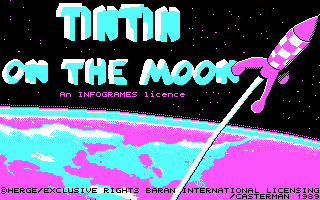
While European home computers like the Amiga enjoyed colorful visuals, this 1989 PC conversion suffered under technical constraints. The graphics rely on basic CGA or Hercules display modes, and the sound is handled entirely by the internal 1-bit PC Speaker. Hearing the engine hum and fire extinguisher squirts through a metallic PC squawker gets tiring fast, and the lack of proper Sound Blaster support strips away whatever mood the original audio had.
The pacing has its own issues. Retrospective reviews often point out that the game can be completed in just 15 to 30 minutes once you know the layout, yet the platforming is frequently ruined by annoying design choices. Randomly spawning blazes pop up out of nowhere, and your rescued companions have a habit of wandering straight back into Jorgen's path. Furthermore, the space segments feel less like a feature and more like an mandatory roadblock standing between you and the actual platforming content.
There is also a quirk with machine speeds: running this action title without capping your processor speed turns the asteroid fields into an unplayable wall of fast-moving rock. Slowing your CPU speed gives you a much fairer chance to weave through the debris field and collect the necessary red spheres.
Why you should play Tintin on the Moon online today
Despite its brief length and brutal asteroid sections, Infogrames nailed the visual style of Hergé's comics. Inside the rocket, the gravity-switching mechanic forces you to float around hazards while juggling your extinguisher spray against Jorgen's sabotage attempts.
If you want to experience this piece of French comic history without battling ancient display modes, you can play Tintin on the Moon online right now. You can jump straight into the pilot seat of the Syldavian rocket free in your browser, with nothing to install. Load it up, toggle the anti-gravity, and see if you can put out Jorgen's fires before the timer runs out.
Players' controls
Touch and gamepad controls
The on-screen keyboard and gamepad mapping the browser player uses on a phone, a tablet or a controller, as opposed to the real keys above. $PRO members make their own in the player and share them here; anyone can pick one to play with.
Make your own touch controlsPRO
- 1Open the editorSign in below, then pick what to make. The game starts with the editor open over it.
- 2Place your keysAdd keys and drag them where your thumbs rest, or map a controller's buttons. Test plays the game with them; Save keeps them, and you play with them from then on.
- 3Share themShare them right after saving in the game, or name and share them here. Players vote, and the best become this game's controls for everyone.
Go PROSee how it worksSign in+20 XP for sharing · +50 XP if yours become the game's own
- The game's own controlsNone yet: played with a real keyboard only.In use
2 screenshots
From the archive
No gameplay video yet
No gameplay video for Tintin on the Moon yet. Sign in to add one.
No reviews yet
Tell the community what you think of Tintin on the Moon. Reviews are public and tied to your username.
No archived manuals for Tintin on the Moon yet
No manuals archived for this title yet. Sign in to upload the first scan.
Cheat codes, console commands and memory pokes for Tintin on the Moon — each one verified and attributed.
Sign in to submitNo cheats yet for this title
Know a working cheat, poke or trainer? Add it with the button above. Moderators check every entry before it goes live.
No archived soundtrack for Tintin on the Moon yet
No soundtrack archived for this title yet. Sign in to upload the first rip.
No save states for Tintin on the Moon yet
No save states for this title yet. Sign in to share one.
Discussions
Sign in to post- Threads0
- Total posts0
- Online now6
Community · Tintin on the Moon
Who's contributing, and what's new
- Reviews0
- Threads0
- Uploadsapproved0
- Contributors0
Recent activity