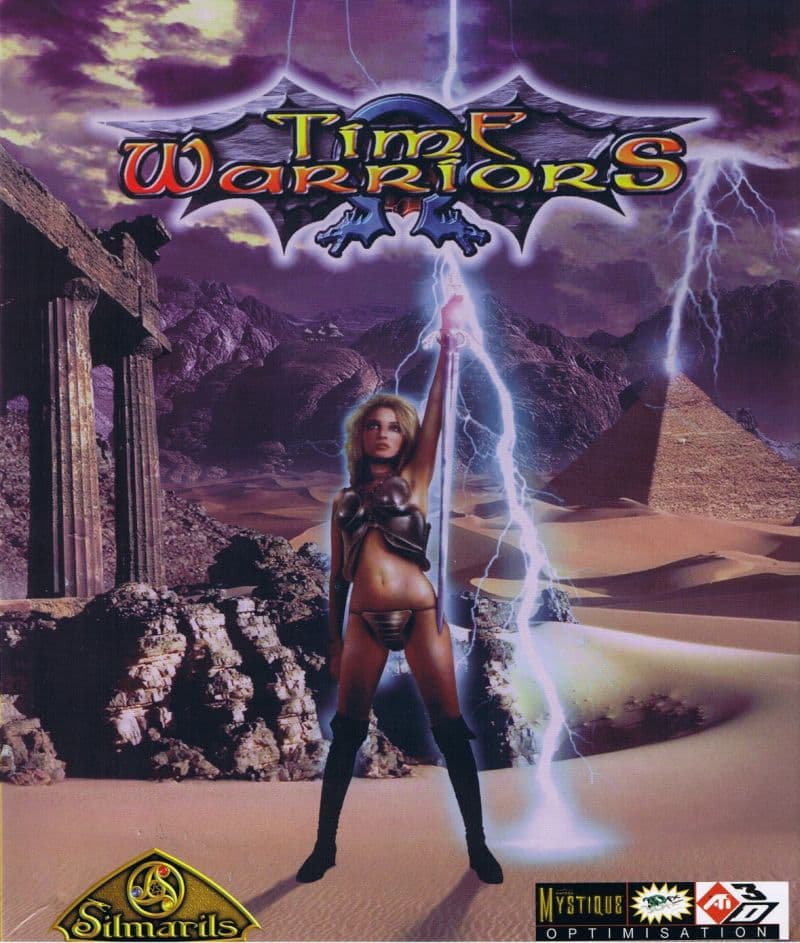
If you played Time Warriors back in 1997, you probably remember how high-resolution SVGA graphics on a PC sound card setup could almost fool you into thinking you were playing an arcade cabinet.
Eight eras collide in Time Warriors
The premise takes eight fighters from completely different eras, brought together after a cataclysm in the year 2000. French developer Silmarils was famous for RPG series like Ishar, so pivoting to a 3D arena fighter was a huge shift. Instead of standard martial artists, the roster brings pure historical chaos: Yrwen the Celt, Hysis the Egyptian, Molloch the Barbarian, Sultan Iz-Baal, Shodan the Samurai, Dong the monk, Olof the Viking, and Apokles the Spartan.
Every fighter relies on a signature weapon rather than bare knuckles. Olof swings a heavy war hammer while Yrwen relies on a long sword. Hysis slices with two sabers, Apokles thrusts with a straight sword sharpened on both edges, and Sultan Iz-Baal slashes with a scimitar. Dong keeps distance with a bo staff, and Molloch chops through armor using a brutal battle axe. There is also an unselectable hidden fighter and a brutal final boss waiting at the end of the ladder.
Dynamic 3D arenas and SVGA visual options
Visually, the game was quite an achievement for an action game on MS-DOS. The 3D polygonal arenas feature dynamic lighting, real-time shadows, and detailed background objects tailored to each character's home era. Knocking an opponent over the arena boundary triggers an instant ring-out victory, stealing notes directly from Sega's Virtua Fighter.
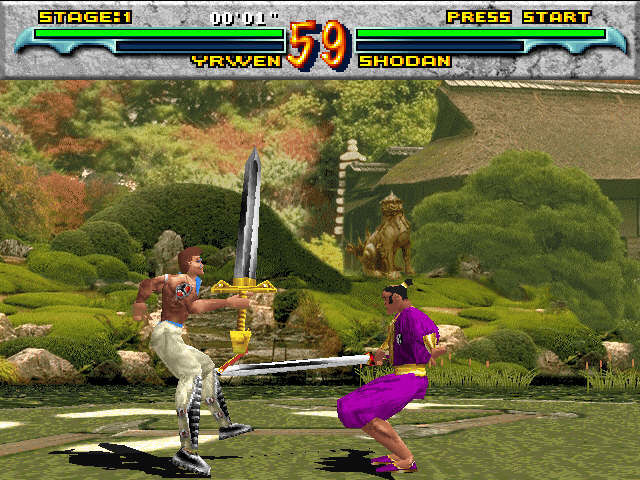
Because graphics hardware was changing rapidly in 1997, the developers included extensive setup menus. You could toggle light sources, textures, dynamic shadow calculations, and background objects to maintain a playable frame rate on mid-range hardware.
Rigid combat and the missing combo system
Controlling your warrior uses a four-button layout: two inputs for weapon strikes and two for kicks, split into fast and strong variants. Taking hits charges a magic meter at the bottom of the screen. Once full, you can unleash a devastating special attack to turn the tide. Standard options cover match length, auto-blocking, and round counts.
Where the game hits a wall is motion. The controls feel rigid, and keypresses lack the fluid response found in contemporary console hits like Tekken 3 or Mortal Kombat 4. Retrospective players and period magazine reviewers both pointed out that true combos are nearly impossible to string together, leaving combat feeling stiff.
Contemporary press verdicts were split across the board:
- PC Team gave it a glowing 88% praise for its high-res visuals.
- PC Player dropped an 81% review, admiring the SVGA engine.
- PC Zone scored it 69%, citing sluggish input response.
- Computer Gaming World gave it 2.5 out of 5 stars, noting average gameplay behind nice graphics.
- PC Fun panned the game severely with a bottom-tier 4 out of 20 score.
How the Time Warriors engine survived
While the game flopped commercially, its engine lived on. Silmarils heavily modified the polygonal rendering tech they built here to power their later fantasy action title, Asghan: The Dragon Slayer. Cheat codes for unlocks and character tweaks even made the rounds in print magazines like Joystick and PC Soluces later that year.
Trying to run the original MS-DOS version today through DOSBox can be tricky because the engine is extremely sensitive to CPU cycle limits. Set your emulator cycles too high or low and the logic loop stutters or crashes completely.
Take your blade into the arena today
If you want to experience this rare piece of PC fighting history without tweaking config files or fighting cycle speeds, you can play Time Warriors free in your browser right now. It takes just a moment to jump in, pick a warrior like Olof or Shodan, and see how weapon combat felt back when SVGA graphics were fighting for space on desktop monitors.