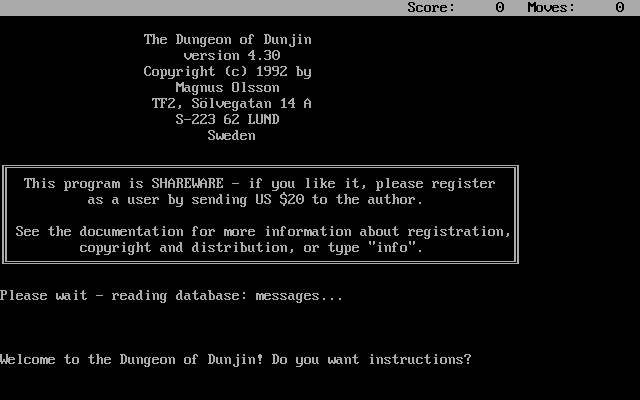
The Dungeons of Dunjin
aka The Dungeon of Dunjin · Dunjin
Playing The Dungeons of Dunjin means stepping into a sprawling 200-room subterranean labyrinth armed with nothing but a text parser and a strict appetite for spatial puzzles.
Into the tourist trap forest of The Dungeons of Dunjin
You begin your quest for the Holy Grail not in a grand castle or a dark ruins site, but in a forest that doubles as a localized tourist spot. Your immediate surroundings include about fifteen surface locations: a few humble tunnels, a small cottage, and an administrative office that feels completely out of place next to the medieval framing. The contrast is deliberate, setting up an adventure that treats its fantasy tropes with a light, almost dry humor.
From those woods, your path leads straight down into a massive underground cavern system spanning roughly two00 interconnected rooms. Unlike many contemporary text adventures that relied on commercial utilities, this engine was built from scratch in Pascal and Assembler by Swedish developer Magnus Olsson over five years of work. The parser handles input cleanly without the lag or bizarre syntax checks that plagued weaker homebrew engines of the late DOS period.
The wooden table and the art of the soft lock
Progress down here relies heavily on inventory management, finding physical keys, and reciting magic incantations to clear locked gates. The real meat of the game, however, lives in its multi-stage physical puzzles. One famous multi-level puzzle requires you to transport and position a heavy wooden table across several rooms to reach a vital ledge. If you leave the table in the wrong spot or drop an essential item early in your descent, you might not realize you have ruined the run until hours later.
This design makes the game finicky to a fault. The map is surprisingly clever, interlinking back into central hubs so you rarely spend ten minutes walking back across empty corridors. But the abundance of hard and soft unwinnable states means that reckless experimentation will get you stuck. If you do not keep separate save files at major milestones, you are bound to hit a wall when a missing item from the surface forest turns out to be mandatory deep in the dragon's lair.
No graphics, no sound, just sheer room count
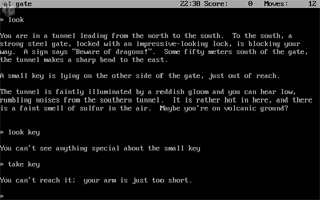
Released as Freeware in 1991, the game completely ignores sound cards. There is no PC speaker bleep, no Sound Blaster music, and no static art to lean on. Everything relies entirely on the quality of its text descriptions and the sheer density of its world.
Despite being written in a second language for the author, the prose is clean. You will struggle to find a single typo or broken grammatical check across the entire map, which puts many other indie text efforts of that period to shame. It keeps its focus strictly on spatial logic and object interaction rather than long winded descriptive prose.
Where to find your footing in Dunjin
The difficulty curve ramps up steadily as you descend past the upper caves, turning into a stern test for anyone who loves old school adventure games. To get through to the rescue of the princess and the slaying of the dragon, you need to treat the environment like a giant mechanical puzzle box.
- Map every direction immediately upon entering a new room.
- Save your game before touching or moving heavy structural items.
- Experiment with key phrases near locked magic gates.
- Keep early items until you are completely sure they served their purpose.
How to play The Dungeons of Dunjin free in your browser today
If you enjoy careful mapping and classic parser logic, you can play The Dungeons of Dunjin online right now. You can run this full MS-DOS game directly in your browser window with nothing to install, giving you immediate access to one of the most ambitious solo text projects of the nineties.