
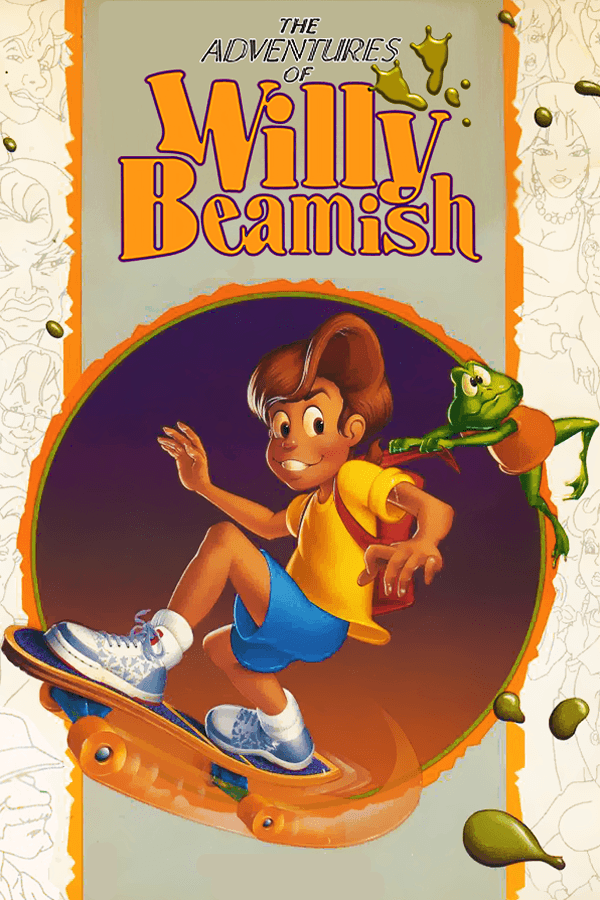

In 1991, The Adventures of Willy Beamish put you in the sneakers of a suburban kid trying to fund a video game tournament entry fee while dodging military school, demonic babysitters, and sudden death around every corner.
Every major puzzle in The Adventures of Willy Beamish hinges on one fundamental mechanical constraint: your parents' fragile patience. Instead of traditional health bars, developer Dynamix, Inc. gave Willy a thermometer on screen called the Trouble-O-Meter. Push your bratty sister Tiffany too far, skip detentions at Carbuncle School, or talk back at the dinner table, and the mercury shoots toward the top label: Cadet School. Once it hits that mark, your summer ends immediately, sending you straight to military academy for an uncompromising game over.
That pressure turns simple household tasks into high-stakes stealth operations. Your main goal seems modest enough at first: train your pet frog Horny to win the $25,000 prize at the Tootsweet Frog Jump Contest in Sloeffer Park. That purse is the only way Willy can afford the $2,500 buy-in for the Nintari Ultimate Champion of the World tournament, a blatant spoof of Nintendo and Atari. Yet between your bedroom and the grand prize lies a maze of strict timelines and lethal household politics.
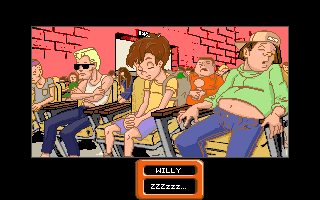
The game splits its time across recognizable spots like the Beamish House, the Tree Fort, and the local Slice of Life Pizza Parlor. You also wander into darker corners of West Frumpton, including the Golden Bowl Bar and the toxic Humpford Sludge Works. As an adventure game, it trades high fantasy for suburban chaos, but its underlying mechanics are every bit as unforgiving as Sierra's deadliest dungeon crawlers.
While the game adopts the point-and-select interface standard for early nineties PC adventures, its puzzle structure relies heavily on trial and error. The dialogue trees are packed with traps where picking a single sarcastic line will instantly ruin a run. If the babysitter Alicia turns demonic, or school bully Spider catches you unprepared in the hallway, making the wrong choice from three options often leads to an instant cutscene of defeat. Compact room layouts mean you rarely get lost wandering empty screens, but missing a narrow action window in a room can soft-lock your story hours later.
You spend a lot of time managing your inventory to solve bizarre real-world problems. Getting out of school early, bribing siblings, or dodging the city's mobbed-up Plumbers' Union Local #409 requires specific items used at exact moments. Sometimes your dead grandfather's ghost appears as a handy floating conscience to drop hints, but even his advice cannot save you if you failed to pick up a key item three scenes back.
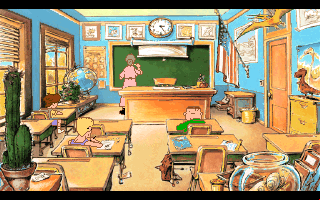
This strict design frustrates players who expect modern safety nets. Retrospective reviews often point out that the logic behind certain choices feels completely arbitrary. You might pick an obvious response in a conversation only to find out it triggers a sequence that makes the frog contest unwinnable. Success requires a crash course in sneaking around and aggressive save-game management.
Under game director Jeff Tunnell, the production aimed for something visually distinct. Lead artist Shawn Sharp and writers Meryl Perutz, Tony Perutz, David Selle, and Tom Brooke constructed the game using the proprietary Dynamix Game Development System (DGDS) engine. Instead of drawing pixel art straight into a computer, artists inked traditional frame-by-frame animation cels and scanned them digitally. The result was a bright, TV-style look that mirrored Saturday morning cartoons, making every reaction face and environmental background pop off the monitor.
Published by Sierra On-Line, Inc., the game proved to be a major commercial success, selling over 80,000 copies in the United States alone within a few months of its late 1991 debut. Yet hardware constraints created famous headaches for owners of the talkie CD-ROM update. Because of single-driver conflicts with standard Sound Blaster hardware, the CD edition famously disabled high-end Roland MT-32 soundtrack support, forcing players to choose between full voice work or superior music synthesis on their PC audio cards.
Players who pushed all the way to the end encountered another famous disappointment: the abrupt resolution. After building the entire narrative around entering the Nintari championship, the story cuts short right before the tournament actually takes place, resolving the villain Leona Humpford's sludge plot while completely skipping the playable video game final. A planned sequel intended to star an older teenage Willy was scrapped, leaving that championship forever unplayed.
Decades later, the hand-crafted visuals remain the game's greatest strength. Watching Willy navigate the Beamish home, mess with his sisters Brianna and Tiffany, or deal with city tycoons feels like controlling a interactive late-eighties comic strip. The voice cast in the later CD release adds plenty of charm, and the underlying satire of suburban life still hits the mark.
What plainly fails to hold up is the unrelenting penalty system. The instant game overs attached to simple menu choices force you to play with one finger constantly resting on the restore key. If you enjoy mapping out puzzle solutions through sheer experimentation and do not mind frequent restarts, the story offers genuine humor and creative setups that few games of the era attempted.
It is a fascinating snapshot of adventure games moving from text parsers to visual comedy, even if its actual mechanics could be mercilessly spiteful to first-time players.
You can play The Adventures of Willy Beamish online free in your browser right now, with no extra setup required. If you want to experience the original The Adventures of Willy Beamish MS-DOS game without digging out old floppy disks or wrestling with vintage audio drivers, the full experience runs directly in your window. To survive your first run, save your progress early and often. Modern players usually expect dialogue trees to offer safe flavor text, but in Frumpton, even a simple sarcastic remark to Willy's mother will fill your Trouble-O-Meter and send you straight to military school before you ever reach the treehouse.
In 1991, The Adventures of Willy Beamish put you in the sneakers of a suburban kid trying to fund a video game tournament entry fee while dodging military school, demonic babysitters, and sudden death around every corner.
Every major puzzle in The Adventures of Willy Beamish hinges on one fundamental mechanical constraint: your parents' fragile patience. Instead of traditional health bars, developer Dynamix, Inc. gave Willy a thermometer on screen called the Trouble-O-Meter. Push your bratty sister Tiffany too far, skip detentions at Carbuncle School, or talk back at the dinner table, and the mercury shoots toward the top label: Cadet School. Once it hits that mark, your summer ends immediately, sending you straight to military academy for an uncompromising game over.
That pressure turns simple household tasks into high-stakes stealth operations. Your main goal seems modest enough at first: train your pet frog Horny to win the $25,000 prize at the Tootsweet Frog Jump Contest in Sloeffer Park. That purse is the only way Willy can afford the $2,500 buy-in for the Nintari Ultimate Champion of the World tournament, a blatant spoof of Nintendo and Atari. Yet between your bedroom and the grand prize lies a maze of strict timelines and lethal household politics.
The game splits its time across recognizable spots like the Beamish House, the Tree Fort, and the local Slice of Life Pizza Parlor. You also wander into darker corners of West Frumpton, including the Golden Bowl Bar and the toxic Humpford Sludge Works. As an adventure game, it trades high fantasy for suburban chaos, but its underlying mechanics are every bit as unforgiving as Sierra's deadliest dungeon crawlers.
While the game adopts the point-and-select interface standard for early nineties PC adventures, its puzzle structure relies heavily on trial and error. The dialogue trees are packed with traps where picking a single sarcastic line will instantly ruin a run. If the babysitter Alicia turns demonic, or school bully Spider catches you unprepared in the hallway, making the wrong choice from three options often leads to an instant cutscene of defeat. Compact room layouts mean you rarely get lost wandering empty screens, but missing a narrow action window in a room can soft-lock your story hours later.
You spend a lot of time managing your inventory to solve bizarre real-world problems. Getting out of school early, bribing siblings, or dodging the city's mobbed-up Plumbers' Union Local #409 requires specific items used at exact moments. Sometimes your dead grandfather's ghost appears as a handy floating conscience to drop hints, but even his advice cannot save you if you failed to pick up a key item three scenes back.
This strict design frustrates players who expect modern safety nets. Retrospective reviews often point out that the logic behind certain choices feels completely arbitrary. You might pick an obvious response in a conversation only to find out it triggers a sequence that makes the frog contest unwinnable. Success requires a crash course in sneaking around and aggressive save-game management.
Under game director Jeff Tunnell, the production aimed for something visually distinct. Lead artist Shawn Sharp and writers Meryl Perutz, Tony Perutz, David Selle, and Tom Brooke constructed the game using the proprietary Dynamix Game Development System (DGDS) engine. Instead of drawing pixel art straight into a computer, artists inked traditional frame-by-frame animation cels and scanned them digitally. The result was a bright, TV-style look that mirrored Saturday morning cartoons, making every reaction face and environmental background pop off the monitor.
Published by Sierra On-Line, Inc., the game proved to be a major commercial success, selling over 80,000 copies in the United States alone within a few months of its late 1991 debut. Yet hardware constraints created famous headaches for owners of the talkie CD-ROM update. Because of single-driver conflicts with standard Sound Blaster hardware, the CD edition famously disabled high-end Roland MT-32 soundtrack support, forcing players to choose between full voice work or superior music synthesis on their PC audio cards.
Players who pushed all the way to the end encountered another famous disappointment: the abrupt resolution. After building the entire narrative around entering the Nintari championship, the story cuts short right before the tournament actually takes place, resolving the villain Leona Humpford's sludge plot while completely skipping the playable video game final. A planned sequel intended to star an older teenage Willy was scrapped, leaving that championship forever unplayed.
Decades later, the hand-crafted visuals remain the game's greatest strength. Watching Willy navigate the Beamish home, mess with his sisters Brianna and Tiffany, or deal with city tycoons feels like controlling a interactive late-eighties comic strip. The voice cast in the later CD release adds plenty of charm, and the underlying satire of suburban life still hits the mark.
What plainly fails to hold up is the unrelenting penalty system. The instant game overs attached to simple menu choices force you to play with one finger constantly resting on the restore key. If you enjoy mapping out puzzle solutions through sheer experimentation and do not mind frequent restarts, the story offers genuine humor and creative setups that few games of the era attempted.
It is a fascinating snapshot of adventure games moving from text parsers to visual comedy, even if its actual mechanics could be mercilessly spiteful to first-time players.
You can play The Adventures of Willy Beamish online free in your browser right now, with no extra setup required. If you want to experience the original The Adventures of Willy Beamish MS-DOS game without digging out old floppy disks or wrestling with vintage audio drivers, the full experience runs directly in your window. To survive your first run, save your progress early and often. Modern players usually expect dialogue trees to offer safe flavor text, but in Frumpton, even a simple sarcastic remark to Willy's mother will fill your Trouble-O-Meter and send you straight to military school before you ever reach the treehouse.
How The Adventures of Willy Beamish is played — the keys the game listens to, grouped by what they do.
Highlighted keys are mapped — hover or tap one to see what it does.
The game relies primarily on point-and-select mouse interactions to move, select dialog, and interact with objects.
The on-screen keyboard and gamepad mapping the browser player uses on a phone, a tablet or a controller, as opposed to the real keys above. $PRO members make their own in the player and share them here; anyone can pick one to play with.
Cheat codes, console commands and memory pokes for The Adventures of Willy Beamish — each one verified and attributed.
Sign in to submitaka Les Aventures de Willy Beamish · הרפתקאות ווילי · The Adventures of Willy Beamish: What if you were nine again... knowing what you know now?
How The Adventures of Willy Beamish is played — the keys the game listens to, grouped by what they do.
Highlighted keys are mapped — hover or tap one to see what it does.
The game relies primarily on point-and-select mouse interactions to move, select dialog, and interact with objects.
The on-screen keyboard and gamepad mapping the browser player uses on a phone, a tablet or a controller, as opposed to the real keys above. $PRO members make their own in the player and share them here; anyone can pick one to play with.
Cheat codes, console commands and memory pokes for The Adventures of Willy Beamish — each one verified and attributed.
Sign in to submit