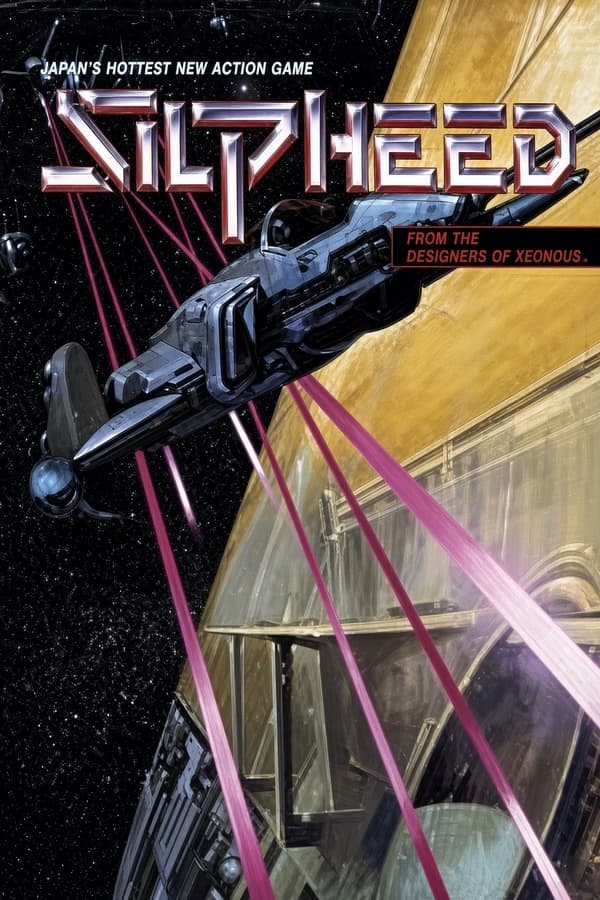
By pitching its vertical corridor backward on a pseudo-3D incline, Silpheed turns standard top-down shooting into a test of spatial calculation where enemy lines dive straight down the screen into your field of fire.
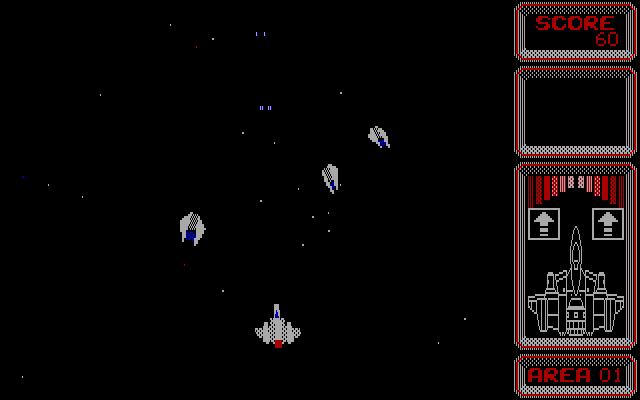
Everything in Silpheed depends on the decision to push the camera back and tilt the plane of play away from the player. Standard overhead shooters ask you to dodge along a flat grid, but taking the SA-77 fighter into this inclined corridor forces you to read depth as well as width. Enemies appearing near the top horizon look small and move slowly across a wireframe grid before dropping sharply into the foreground where their hitboxes quickly widen.
That perspective alters how you choose armaments between levels. You carry independent hardpoints on the left and right sides of your ship, along with a selectable sub-weapon pool that includes the Graviton Bomb, EM Defense System, Photon Torpedo, and Anti-Matter Bomb. Lining up dual forward cannons against snake-like enemy formations requires anticipating where their path meets your flight vector three seconds before the collision occurs.
The combat loop rewards careful points banking between stages because wing configuration dictates how efficiently you clear waves. Mid-stage items drop periodically to supply temporary invincibility, screen-clearing wipes, shield recharges, or continuous auto-fire, but relying on drops alone will fail you once the screen fills with overlapping bullet arcs.
Instead of instantaneous death on contact, taking a hit strips away specific ship functions. A damaged wing results in weapon failure on that side, leaving your attack pattern uneven, while heavy hull damage makes your flight controls erratic and sluggish. Flying a crippled SA-77 through dense asteroid fields with only one working hardpoint is nerve-wracking, and I found that losing a weapon late in a stage usually signals a slow death long before your shield points hit zero.
When publisher Sierra On-Line, Inc. brought this Game Arts Co., Ltd. production to IBM PC compatibles in 1989, computer sound was dominated by internal squeakers. Sierra treated composition as a primary feature, routing score duties to synth hardware like the Roland MT-32 module. The musical arrangements by Fumihito Kasatani, Nobuyuki Aoshima, Masakuni Mitsuhashi, and Hibiki Godai sound full and dynamic over MIDI channels, giving this arcade shooter an audio presentation that rivalled dedicated arcade hardware of the era.
Period gaming press took immediate notice of the production quality. Issue #151 of Dragon magazine awarded the game 5 out of 5 stars, noting that it was highly addictive and required hours of practice to master, while Computer Gaming World singled out the original soundtrack for praise. Players listening on basic PC speakers missed out on rich synth tones, though a rare OEM release offered native AdLib support for expanded audio without requiring an expensive synth box.
The visual engine relies on 16-color EGA rendering to draw polygonal background elements over tilted backdrops. While planetary atmospheres and open starfields present clean geometric silhouettes, moving inside enemy installations exposes visual limitations. Reviewers rightly pointed out that interior base corridors look washed out and monochromatic, turning structural walls into repetitive color blocks that lack definition.
The game also develops a punishing difficulty curve in its final third. Reclaiming the central computer system Grayzon and defeating the fleet commander Xacalite to take back Gloire requires navigating an unforgiving final boss rush. The precision needed to survive these encounters is extreme, making it especially frustrating that the reward for surviving the final gauntlet is a brief, sparse text ending sequence that barely acknowledges your effort.
For players who hit an insurmountable wall near the end, programmer Satoshi Uesaka and the design team left quick jump inputs in the code. Pressing F9 reloads your game to the stage past the last one you successfully cleared, while F10 instantly drops your ship into Level 16. These built-in shortcuts cut through the tedious restart loop when practicing late-stage patterns.
This action title is a sharp, challenging entry in late-eighties arcade design. The angled plane forces you to learn spatial judgment that traditional flat shooters never demand, and managing dual hardpoint damage keeps tension high through every stage. If you enjoy precision shmups that demand fast reflexes and smart loadout planning, spend an evening mastering its trajectory physics.
You can launch this Silpheed MS-DOS game straight from your web browser without downloading software or setting up disk images. Modern players often expect a standard top-down view and get caught off guard by how fast enemies close distance along the tilted grid, so pick balanced wing cannons early to keep the center lane clear. You can play Silpheed online free in your browser right now and take your own run at Xacalite's fleet.
By pitching its vertical corridor backward on a pseudo-3D incline, Silpheed turns standard top-down shooting into a test of spatial calculation where enemy lines dive straight down the screen into your field of fire.
Everything in Silpheed depends on the decision to push the camera back and tilt the plane of play away from the player. Standard overhead shooters ask you to dodge along a flat grid, but taking the SA-77 fighter into this inclined corridor forces you to read depth as well as width. Enemies appearing near the top horizon look small and move slowly across a wireframe grid before dropping sharply into the foreground where their hitboxes quickly widen.
That perspective alters how you choose armaments between levels. You carry independent hardpoints on the left and right sides of your ship, along with a selectable sub-weapon pool that includes the Graviton Bomb, EM Defense System, Photon Torpedo, and Anti-Matter Bomb. Lining up dual forward cannons against snake-like enemy formations requires anticipating where their path meets your flight vector three seconds before the collision occurs.
The combat loop rewards careful points banking between stages because wing configuration dictates how efficiently you clear waves. Mid-stage items drop periodically to supply temporary invincibility, screen-clearing wipes, shield recharges, or continuous auto-fire, but relying on drops alone will fail you once the screen fills with overlapping bullet arcs.
Instead of instantaneous death on contact, taking a hit strips away specific ship functions. A damaged wing results in weapon failure on that side, leaving your attack pattern uneven, while heavy hull damage makes your flight controls erratic and sluggish. Flying a crippled SA-77 through dense asteroid fields with only one working hardpoint is nerve-wracking, and I found that losing a weapon late in a stage usually signals a slow death long before your shield points hit zero.

When publisher Sierra On-Line, Inc. brought this Game Arts Co., Ltd. production to IBM PC compatibles in 1989, computer sound was dominated by internal squeakers. Sierra treated composition as a primary feature, routing score duties to synth hardware like the Roland MT-32 module. The musical arrangements by Fumihito Kasatani, Nobuyuki Aoshima, Masakuni Mitsuhashi, and Hibiki Godai sound full and dynamic over MIDI channels, giving this arcade shooter an audio presentation that rivalled dedicated arcade hardware of the era.
Period gaming press took immediate notice of the production quality. Issue #151 of Dragon magazine awarded the game 5 out of 5 stars, noting that it was highly addictive and required hours of practice to master, while Computer Gaming World singled out the original soundtrack for praise. Players listening on basic PC speakers missed out on rich synth tones, though a rare OEM release offered native AdLib support for expanded audio without requiring an expensive synth box.
The visual engine relies on 16-color EGA rendering to draw polygonal background elements over tilted backdrops. While planetary atmospheres and open starfields present clean geometric silhouettes, moving inside enemy installations exposes visual limitations. Reviewers rightly pointed out that interior base corridors look washed out and monochromatic, turning structural walls into repetitive color blocks that lack definition.
The game also develops a punishing difficulty curve in its final third. Reclaiming the central computer system Grayzon and defeating the fleet commander Xacalite to take back Gloire requires navigating an unforgiving final boss rush. The precision needed to survive these encounters is extreme, making it especially frustrating that the reward for surviving the final gauntlet is a brief, sparse text ending sequence that barely acknowledges your effort.

For players who hit an insurmountable wall near the end, programmer Satoshi Uesaka and the design team left quick jump inputs in the code. Pressing F9 reloads your game to the stage past the last one you successfully cleared, while F10 instantly drops your ship into Level 16. These built-in shortcuts cut through the tedious restart loop when practicing late-stage patterns.
This action title is a sharp, challenging entry in late-eighties arcade design. The angled plane forces you to learn spatial judgment that traditional flat shooters never demand, and managing dual hardpoint damage keeps tension high through every stage. If you enjoy precision shmups that demand fast reflexes and smart loadout planning, spend an evening mastering its trajectory physics.
You can launch this Silpheed MS-DOS game straight from your web browser without downloading software or setting up disk images. Modern players often expect a standard top-down view and get caught off guard by how fast enemies close distance along the tilted grid, so pick balanced wing cannons early to keep the center lane clear. You can play Silpheed online free in your browser right now and take your own run at Xacalite's fleet.
How Silpheed is played — the keys the game listens to, grouped by what they do.
Highlighted keys are mapped — hover or tap one to see what it does.
Music volume adjustment requires a supported sound card. The installer program (INSTALL) must be run prior to playing if configuring from floppies.
The on-screen keyboard and gamepad mapping the browser player uses on a phone, a tablet or a controller, as opposed to the real keys above. $PRO members make their own in the player and share them here; anyone can pick one to play with.
Cheat codes, console commands and memory pokes for Silpheed — each one verified and attributed.
Sign in to submitHow Silpheed is played — the keys the game listens to, grouped by what they do.
Highlighted keys are mapped — hover or tap one to see what it does.
Music volume adjustment requires a supported sound card. The installer program (INSTALL) must be run prior to playing if configuring from floppies.
The on-screen keyboard and gamepad mapping the browser player uses on a phone, a tablet or a controller, as opposed to the real keys above. $PRO members make their own in the player and share them here; anyone can pick one to play with.
Cheat codes, console commands and memory pokes for Silpheed — each one verified and attributed.
Sign in to submit