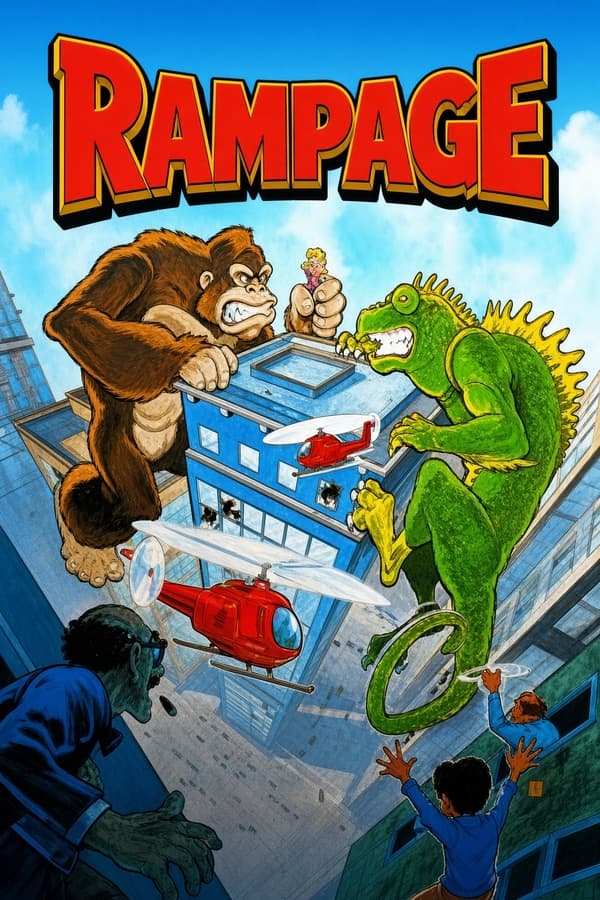
Playing Rampage in 1988 meant taking three regular citizens turned into giant mutant beasts and tearing down North America one brick, bus, and military chopper at a time.
Booting up this action port drops you straight into the chaos without much ceremony. You pick your monster: George the giant gorilla, Lizzy the lizard, or Ralph the werewolf. From a side-view perspective, your goal is simple: scale the sides of buildings, punch out the windows, and smash the structure until it collapses under its own weight.
Smashing windows reveals useful snacks like plants, goldfish, and unsuspecting office workers that restore your health bar. But you have to watch what you grab. Chomp down on a toaster grill or a plugged-in television and your monster takes a nasty electrical shock, sending you sliding down the wall. Meanwhile, soldiers fire from windows, police cars and tanks shell you from the street, and helicopters hover overhead to pick at your health pool.
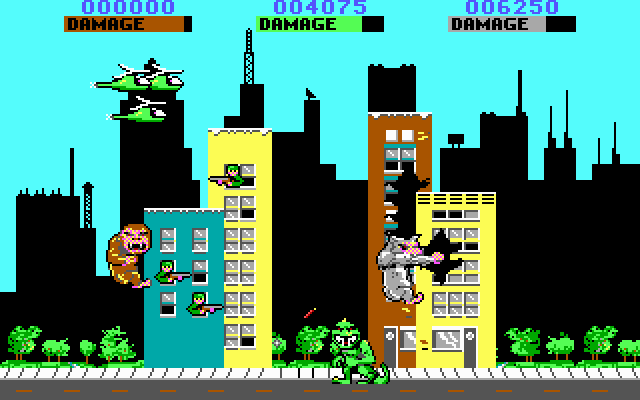
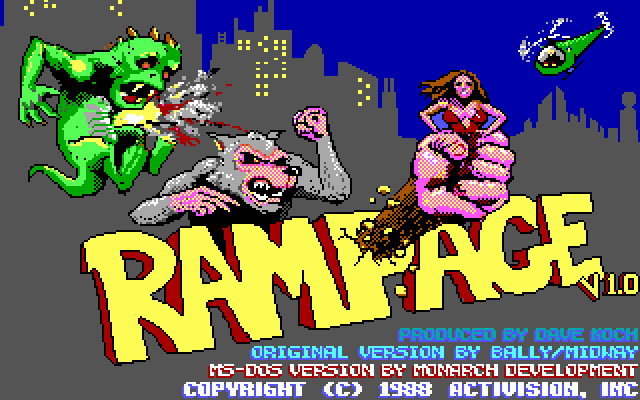
The original arcade hit was designed by Brian Colin and Jeff Nauman at Bally Midway Mfg Co. with distinct art by Sharon Perry and music by Michael Bartlow. When Monarch Development handled the MS-DOS conversion for publisher Activision, Inc., the priority was preserving the multiplayer arcade experience. Up to three players can crowd around one keyboard to cause total destruction simultaneously across 128 days of North American cities, from Chicago and New York to Plano.
Back in 1988, running this game on an IBM PC in 16-color EGA mode was a genuine statement. Computer Gaming World praised the adaptation for fast PCs, pointing out that it proved IBM machines could run fast entertainment software just as well as competing home computers. But bringing an arcade quarter-snatcher home also meant exposing its design limitations. Without the threat of losing real coins, the loop of climbing, punching, and eating turns repetitive over long solo sessions.
The DOS port carries a few quirks that fans still talk about today. There are no native built-in cheat codes in this version, so you have to survive on health items alone. If your health meter runs out, your monster shrinks back into a confused, naked human and sheepishly walks off the side of the screen. You will also run into a classic DOS bug where your monster can unexpectedly crawl up thin air along broken edges where building tiles no longer exist.
The trickiest part of playing the 1988 release today is getting past the character setup. Abandonware players frequently get stuck on the initial control mapping screen, not realizing that you must press Escape to bypass unused player slots if you want to play solo. On top of that, running the game on modern processors without adjusting CPU cycles makes the action run at warp speed, turning the city destruction into an unplayable blur.
While the loop can wear thin by the twentieth city, the core loop of tearing down a skyline with two friends remains great fun. The DOS graphics hold up surprisingly well, capturing the cartoonish violence of the arcade original without taking itself seriously.
You can play Rampage online for free right in your browser. There is no setup to deal with, so you can jump straight into punching buildings, swiping helicopters out of the air, and causing mass urban destruction in seconds.
Playing Rampage in 1988 meant taking three regular citizens turned into giant mutant beasts and tearing down North America one brick, bus, and military chopper at a time.
Booting up this action port drops you straight into the chaos without much ceremony. You pick your monster: George the giant gorilla, Lizzy the lizard, or Ralph the werewolf. From a side-view perspective, your goal is simple: scale the sides of buildings, punch out the windows, and smash the structure until it collapses under its own weight.
Smashing windows reveals useful snacks like plants, goldfish, and unsuspecting office workers that restore your health bar. But you have to watch what you grab. Chomp down on a toaster grill or a plugged-in television and your monster takes a nasty electrical shock, sending you sliding down the wall. Meanwhile, soldiers fire from windows, police cars and tanks shell you from the street, and helicopters hover overhead to pick at your health pool.
The original arcade hit was designed by Brian Colin and Jeff Nauman at Bally Midway Mfg Co. with distinct art by Sharon Perry and music by Michael Bartlow. When Monarch Development handled the MS-DOS conversion for publisher Activision, Inc., the priority was preserving the multiplayer arcade experience. Up to three players can crowd around one keyboard to cause total destruction simultaneously across 128 days of North American cities, from Chicago and New York to Plano.
Back in 1988, running this game on an IBM PC in 16-color EGA mode was a genuine statement. Computer Gaming World praised the adaptation for fast PCs, pointing out that it proved IBM machines could run fast entertainment software just as well as competing home computers. But bringing an arcade quarter-snatcher home also meant exposing its design limitations. Without the threat of losing real coins, the loop of climbing, punching, and eating turns repetitive over long solo sessions.
The DOS port carries a few quirks that fans still talk about today. There are no native built-in cheat codes in this version, so you have to survive on health items alone. If your health meter runs out, your monster shrinks back into a confused, naked human and sheepishly walks off the side of the screen. You will also run into a classic DOS bug where your monster can unexpectedly crawl up thin air along broken edges where building tiles no longer exist.
The trickiest part of playing the 1988 release today is getting past the character setup. Abandonware players frequently get stuck on the initial control mapping screen, not realizing that you must press Escape to bypass unused player slots if you want to play solo. On top of that, running the game on modern processors without adjusting CPU cycles makes the action run at warp speed, turning the city destruction into an unplayable blur.
While the loop can wear thin by the twentieth city, the core loop of tearing down a skyline with two friends remains great fun. The DOS graphics hold up surprisingly well, capturing the cartoonish violence of the arcade original without taking itself seriously.
You can play Rampage online for free right in your browser. There is no setup to deal with, so you can jump straight into punching buildings, swiping helicopters out of the air, and causing mass urban destruction in seconds.
How Rampage is played — the keys the game listens to, grouped by what they do.
Highlighted keys are mapped — hover or tap one to see what it does.
Default in-game directional/action keys for each monster are omitted in the manual text as players configure custom key combinations in the set-up screen.
The on-screen keyboard and gamepad mapping the browser player uses on a phone, a tablet or a controller, as opposed to the real keys above. $PRO members make their own in the player and share them here; anyone can pick one to play with.
Cheat codes, console commands and memory pokes for Rampage — each one verified and attributed.
Sign in to submitHow Rampage is played — the keys the game listens to, grouped by what they do.
Highlighted keys are mapped — hover or tap one to see what it does.
Default in-game directional/action keys for each monster are omitted in the manual text as players configure custom key combinations in the set-up screen.
The on-screen keyboard and gamepad mapping the browser player uses on a phone, a tablet or a controller, as opposed to the real keys above. $PRO members make their own in the player and share them here; anyone can pick one to play with.
Cheat codes, console commands and memory pokes for Rampage — each one verified and attributed.
Sign in to submit