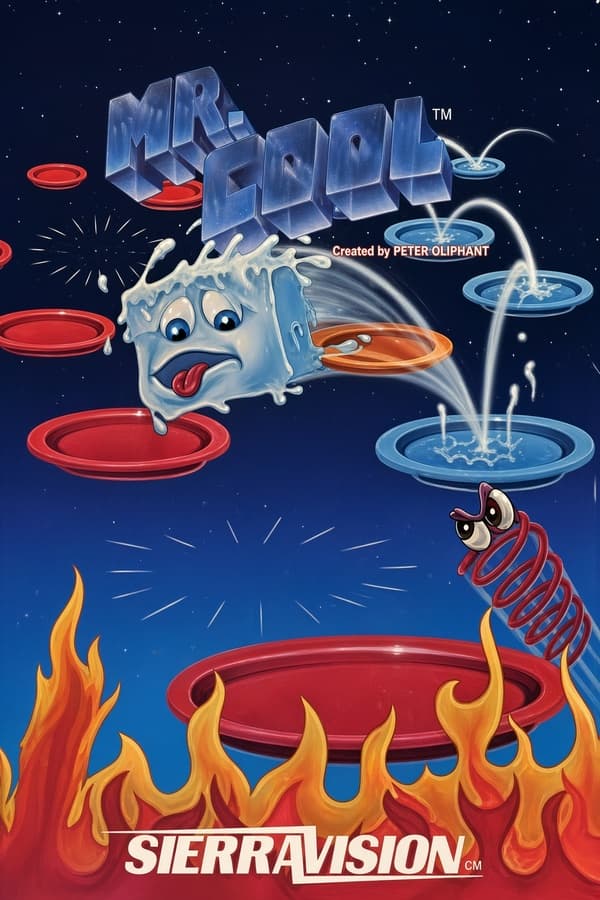
In Mr. Cool, you control a slippery ice cube jumping across a seven-tiered grid of red-hot plates, turning a clear arcade clone into an anxious exercise in survival.
A fast alternative to the arcade pyramid craze
Designer Peter Oliphant was a devoted player of Gottlieb's isometric pyramid hit, but he felt the original rhythm dragged once you understood the basic landing patterns. He built the original version in three weeks to give players something faster, stripping away cartoon speech bubbles and focusing entirely on speed. Programmer John Redekopp brought that design to the IBM PC for Sierra On-Line in 1983 as a self-booting disk, delivering a direct port of the concept to early home computer displays.
The core setup is immediately familiar to anyone who spent time in arcades during the early eighties. You stand at the top of a seven-tiered structure composed of heated stoves, hopping diagonally between platforms to change their state until the whole grid matches your objective color. Because the screen is drawn as a flat, angled grid, figuring out where your ice cube will land demands complete focus from your very first jump.
While magazines like Softline acknowledged that the presentation lacked visual flourish, they noted that the central loop was no less addictive than the arcade inspiration. It trades decorative character animation for aggressive hazard placement and a strict timer, turning a familiar action game formula into a test of quick reflexes.
Surviving fireballs and bouncing springs in Mr. Cool
Movement on the pyramid requires shifting along four diagonal axes, which means every jump carries a real risk of leaping completely off the structure if your timing slips. Fireballs streak horizontally across the grid without warning, cutting off whole tiers and forcing you into sudden retreats. At the same time, hot springs drop down from the top platform, bouncing down the tiers toward your position and forcing you to calculate two different threat angles at once.
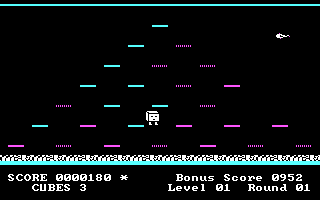
Your main defensive tool is Supercool Time, an emergency mode you can activate once per level for fifteen seconds. Triggering this ability reverses the balance of power on the screen immediately. Fireballs instantly freeze into passive snowballs, and the lethal hot springs turn into harmless cold springs that yield bonus points when collected.
- Assess the target color requirement before making your first leap from the top tier.
- Clear the upper rows early so you are not trapped at the top when hot springs spawn.
- Save Supercool Time for mid-level scrambles when fireballs block both lower escape routes.
- Scoop up frozen hazards while Supercool Time is active to rack up essential extra points.
Using Supercool Time early in a fifteen-round set usually leaves you completely helpless during later, faster waves. The best runs rely on precise diagonal hopping until the hazard density becomes completely unmanageable, holding the fifteen-second freeze for moment-to-moment survival rather than high-score hunting.
Where diagonal controls and round 11 break most runs
The difficulty curve in this PC edition hits an absolute brick wall early in a long session. Reviewing the release for Creative Computing, writer Arthur Leyenberger pointed out that many players struggled to register diagonal inputs reliably on standard PC joysticks or keyboards. Missing a diagonal input often sends your ice cube tumbling into empty space, draining your extra lives on simple input errors rather than bad decision-making.
Beyond the control issues, the game ramps up its demands sharply when you reach round 11. Early rounds let you clear plates with a single landing, but later stages force you to land on the same hot plate two or more times to match the target color, all while the overall game speed steadily accelerates. The combination of multi-hit plates, erratic spring bounces, and unforgiving diagonal controls turns later rounds into a chaotic fight to stay alive.
That sudden spike in speed separates casual attempts from serious runs. When fireballs cross the bottom rows at top speed while two springs bounce down from above, finding a safe platform requires reading four moves ahead while executing sharp diagonal inputs on a standard PC keyboard.
Why Mr. Cool is worth testing in your browser today
The simple presentation shows its age quickly, but the underlying panic of juggling multiple hazards on a small grid holds up well. It strips away fluff to focus entirely on movement and timing. If you enjoy arcade-style endurance tests where a single wrong move destroys a great run, this PC release offers an intense, immediate challenge that tests your spatial awareness.
The single-hit mechanics, raw platforming layout, and high-stakes survival loop make it a great historical sample of early IBM PC gaming. It relies purely on player accuracy and quick decision-making under stress rather than elaborate power-up systems or long level progression.
You can play Mr. Cool free in your browser right now, with full keyboard controls mapped and ready to go in one click. Try to survive through the early rounds without burning your single Supercool Time activation too early, and see how your diagonal hopping handles the sudden speed leap at round 11.