
Machiavelli The Prince
aka Merchant Prince
Rate this game
- Played
- A lot
In Machiavelli The Prince, your initial voyage out of 14th-century Venice feels like a basic exercise in ledger management until false rumors lead your galleys off the map and a bribed cardinal excommunicates your largest trading rival.
From Merchant Prince to a MicroProse black box
When designer Ed Pike set out to upgrade his 1993 title Merchant Prince, he took the project to Holistic Design, Inc. and teamed up with programmers Ken Lightner, Rob Lefebvre, and Andrew Hackett. Published by MicroProse Software, Inc. in 1995, the resulting MS-DOS strategy game pushed the original concept into SVGA visual detail, complete with art by Pike, Cris-Jon Lindsay, and Kathy Nielson alongside a new soundtrack composed by Lefebvre. MicroProse leaned into the Renaissance cynicism of the source material so heavily that physical retail releases of the game in its black box edition included an actual paperback copy of Niccolò Machiavelli's 1532 political treaty published by Penguin Books.
The core proposition was simple: take control of one of the dominant merchant families in Venice and build a empire across land and sea. You start on a top-down view of Europe and the Mediterranean, managing fleets of galleys, organizing land caravans, and trying to profit off commodity price gaps across more than 40 historical cities. Yet the map is not a reliable grid. Regions far from home are obscured by fog or distorted by inaccurate historical rumors, forcing you to send out exploratory expeditions just to confirm whether a port actually trades in silk or simply exists as a coastline hazard.
Buying silk, bribing the Pope, and braving distorted maps in Machiavelli The Prince
A typical turn begins inside the ledger menus where you buy low in one port and set a sailing route for somewhere desperate enough to pay double. Money flows quickly, but profit is only half the design. To win real political control, you have to spend those florins on underhanded operations back in Rome and Venice.
The political screen lets you deploy an array of ruthless tactics against competing merchant houses:
- Bribing cardinals to secure influence within the Church of Rome and swing papal elections.
- Spreading slander to ruin a competitor's reputation and lower their political standing.
- Hiring mercenary armies to capture land nodes or defend trade routes from hostile neighbors.
- Ordering covert assassinations against rival family heads to disrupt their corporate leadership.
Navigating these choices creates a constant tension between commercial growth and survival. A profitable trade fleet is useless if a rival city sends pirates after your cargo or a sudden outbreak of the Plague sweeps through your primary harbor, killing off crews and freezing trade routes.
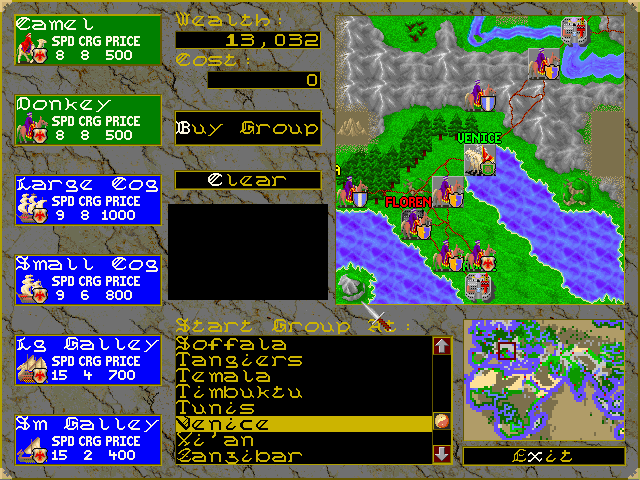
Where the political simulation starts to fray
At the time of release, gaming magazines split sharply over whether the heavy routine of economic maintenance paid off. PC Zone rated it an 89, calling it a Colonization-style simulation loaded with political intrigue, while Computer Gaming World awarded it 4 out of 5 stars for its strategic depth. French outlets Joystick and Gen4 handed out scores of 89% and 83% respectively, and PC Gamer US sat nearby at 84%. However, reviewer David "Zeb" Cook took a harsher stance in Issue 220 of Dragon Magazine, writing that it "quickly becomes a game of doing the same old thing over and over" without fully mining the richness of its Renaissance setting. A month later, reviewers Jay & Dee gave it a modest 3 out of 5 stars in Dragon Issue 221.
Cook was not wrong about the mid-game repetition. Once you establish automated trade loops across several dozen ports, managing the mechanical side of your network becomes a chore. The interface exposes a few glaring design flaws as well. The most infamous is the trade route Plague bug: if your unit encounters a city suffering from an outbreak and you explicitly instruct it not to trade, a lack of remaining movement points will cause the unit to force a transaction anyway on the next turn, infecting your crew. Another quirk lives in guard management, where selecting Heavy or Light guards for a caravan is completely overwritten the second your unit touches a new town, forcing them to swap their escort for whatever local guard type that specific city sells.
Player communities eventually circulated a money cheat patch on early shareware discs to bypass the early financial grind. Even with the bugs, the game came with a surprisingly packed set of multiplayer options: local area network support, modem dial-up connections, and a dedicated Play-by-E-Mail (PBEM) mode that let groups of human players scheme against each other over real-world weeks.
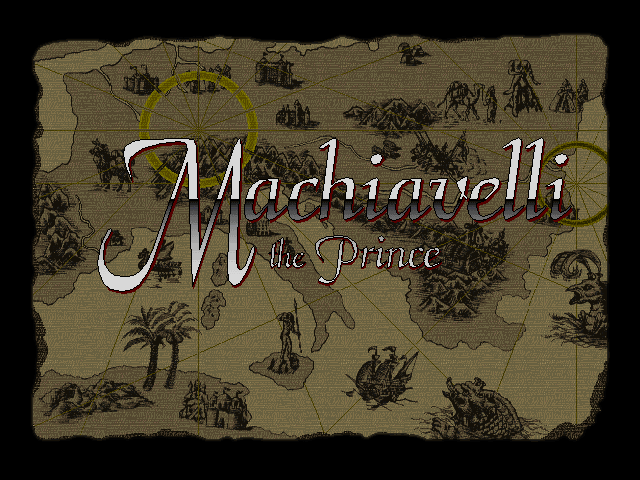
Play Machiavelli The Prince online and scheme for Venice tonight
Despite its late-game micromanagement headaches, this Machiavelli The Prince MS-DOS game gets the cutthroat feel of Renaissance trade down better than most modern titles that attempt the same premise. It gave rise to a direct sequel, Merchant Prince II, in 2001, though the 1995 release is still the purest take on Pike's design. If you want to see how it plays, you can play Machiavelli The Prince online free in your browser right now with no setup needed. Spend ten minutes setting up your first fleet out of Venice, bribe a cardinal on turn five, and see how long your merchant house survives before the Pope excommunicates your best captain.
How Machiavelli The Prince is played — the keys the game listens to, grouped by what they do.
- Interface
Highlighted keys are mapped — hover or tap one to see what it does.
The game relies primarily on mouse interactions for spatial map navigation, as keyboard map movement is not provided.
Players' controls
Touch and gamepad controls
The on-screen keyboard and gamepad mapping the browser player uses on a phone, a tablet or a controller, as opposed to the real keys above. $PRO members make their own in the player and share them here; anyone can pick one to play with.
Make your own touch controlsPRO
- 1Open the editorSign in below, then pick what to make. The game starts with the editor open over it.
- 2Place your keysAdd keys and drag them where your thumbs rest, or map a controller's buttons. Test plays the game with them; Save keeps them, and you play with them from then on.
- 3Share themShare them right after saving in the game, or name and share them here. Players vote, and the best become this game's controls for everyone.
Go PROSee how it worksSign in+20 XP for sharing · +50 XP if yours become the game's own
- The game's own controlsKeyboardGamepadWhat every player starts with.In use
2 screenshots
From the archive
No gameplay video yet
No gameplay video for Machiavelli The Prince yet. Sign in to add one.
No reviews yet
Tell the community what you think of Machiavelli The Prince. Reviews are public and tied to your username.
No archived manuals for Machiavelli The Prince yet
No manuals archived for this title yet. Sign in to upload the first scan.
Cheat codes, console commands and memory pokes for Machiavelli The Prince — each one verified and attributed.
Sign in to submitNo cheats yet for this title
Know a working cheat, poke or trainer? Add it with the button above. Moderators check every entry before it goes live.
No archived soundtrack for Machiavelli The Prince yet
No soundtrack archived for this title yet. Sign in to upload the first rip.
No save states for Machiavelli The Prince yet
No save states for this title yet. Sign in to share one.
Discussions
Sign in to post- Threads0
- Total posts0
- Online now6
Community · Machiavelli The Prince
Who's contributing, and what's new
- Reviews0
- Threads0
- Uploadsapproved0
- Contributors0
Recent activity
Nothing here yet
Reviews, discussion threads and approved uploads appear here as members add them.