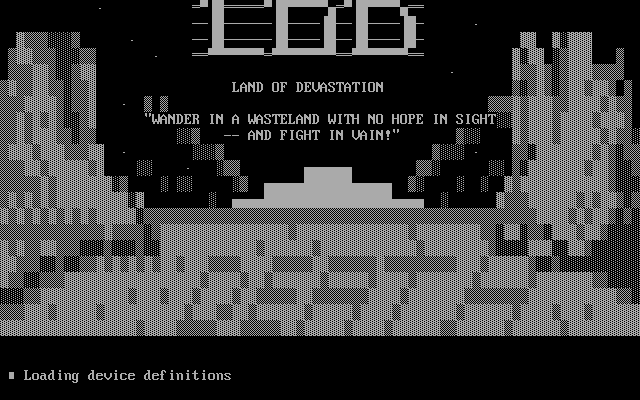
In Land Of Devastation, surviving the post-nuclear fallout is only half the battle; the real trick is dragging stolen Puritron atmospheric filters back to Sacre Base before another player razes your custom wasteland fortress.
During the early nineties, computer bulletin board systems ran almost entirely on monochrome text or standard 80-column ANSI blocks. Players who logged into remote doors expected simple text prompts, slow terminal refreshes, and computer beeps. Programmer Dr. Scott M. Baker took a completely different path by creating a dedicated SVGA terminal front-end called GTERM, turning a online door title into a full graphical experience with high-resolution imagery and digitized sound.
You drop into the radio-damaged wilderness as a lone human survivor following a total nuclear holocaust. Mutant hordes have looted the Puritron, a vital atmospheric scrubbing machine, and scattered its vital components across toxic ruins, ruined cities, and hidden underground shelters. Your main task requires exploring the map, fighting off hostile creatures, recovering those missing machine parts, and returning them safely to the sanctuary of Sacre Base.
To fit this entire simulation into standard DOS memory, the code was written in Borland Pascal with embedded 386 assembly language for high-speed screen drawing routines. The game squeezed itself into roughly 520 kilobytes of free memory using heavily overlaid executable structures. That technical ambition paid off, eventually securing over 1,620 paid registered system operators who hosted the wasteland on their private boards.
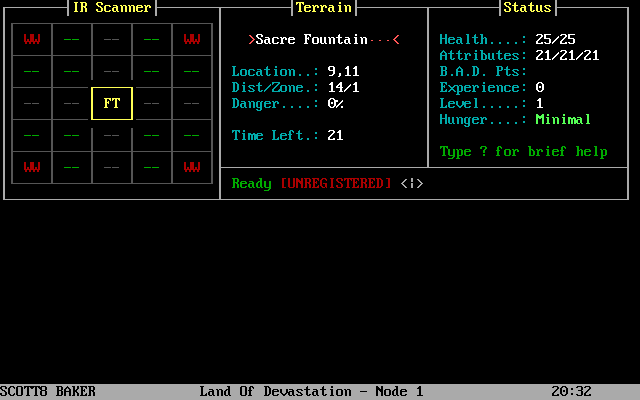
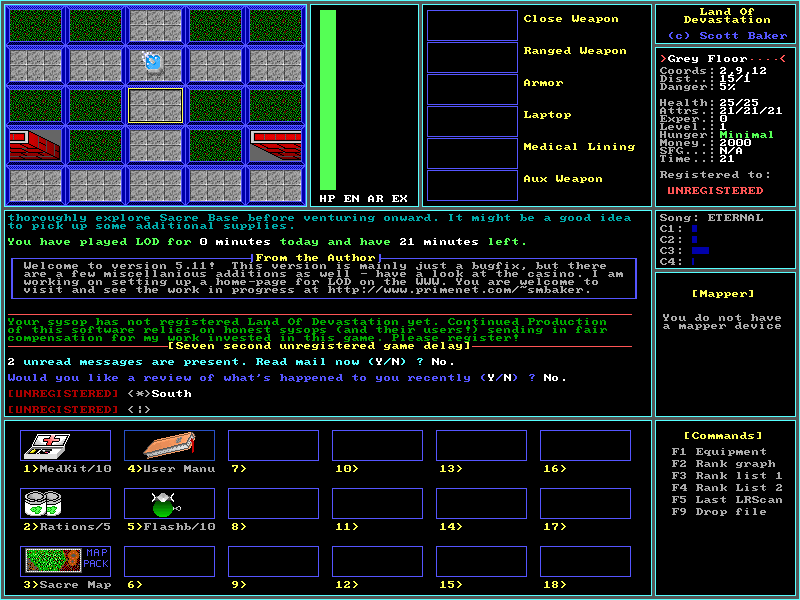
Stepping out of Sacre Base for the first time hits you with a steep learning curve. Tactical combat uses menu selections for short-range firearms, long-range rifles, specialized armor, and defensive shields. Survival relies heavily on utilitarian gear, including portable laptops for data decryption, medical kits to mend broken limbs, personal stealth fields for avoiding patrols, long-distance warpers, and physical security keys.
The loop expands dramatically once you earn enough money to alter the landscape itself. Instead of relying solely on premade safe zones, players can construct custom fortresses anywhere out in the radio-damaged wilderness. Building a fortress lets you charge tolls to passing players, store surplus gear in private vaults, and sell specialized commodities to line your bank account.
Player characters remain vulnerable even after their owners log off for the night. Opponents can assault your offline character or lay siege to your custom outposts while you sleep. To prevent a single bad ambush from wiping out weeks of progress, Sacre Base houses a cloning facility where you pay a credit fee to duplicate your stats; when an ambush kills your active survivor, your backup clone wakes up in the medical bay without losing hard-won levels.
The code contained a infamous technical hiccup that haunted players for years after fast machines arrived. Programs compiled with Borland Pascal tended to crash instantly on processors running faster than 200 megahertz, throwing a fatal Runtime 200 Error before displaying a single menu. Fans had to hunt down executable patches like lodfix1.zip just to bypass the fast timing loops on later hardware.
Despite those compiler quirks, the production detail went far beyond typical independent releases. Artists Dave Rosson, Andy Weber, and Christopher Darque crafted detailed tile artwork, while musicians Doug Merha and Chris Azure composed background tunes using 4-voice MOD audio files streamed directly through the terminal client. Baker even built a custom scripting language called LGPL, allowing system operators to code their own items, unique locations, and post-apocalyptic narrative arcs.
The main tension comes from managing real risk across a shared world. The constant threat of offline raids gives every fortress build genuine stakes, while the deep inventory system rewards long-term planning over quick reflexes. Compared to standard Role-playing (RPG) games published around 1996 under the Scott M. Baker label, the depth of character persistence remains impressive.
The control interface displays its age through heavy reliance on sub-menus and keyboard shortcuts that require frequent manual checks. Navigating nested menu windows to swap weapons mid-fight slows down action sequences, and configuring custom terminal software was notoriously temperamental on vintage telephone line setups. Yet for players who appreciate slow-burn economic strategy alongside tactical mutant hunting, the core design logic remains solid.
Anyone who enjoys classic strategy and survivor progression will find plenty to dig into here. The strategic layer of managing fortress tolls, securing cloned backups, and hunting down Puritron components offers a flavor of multiplayer interaction that modern titles rarely replicate. You do not need to hunt down original patches, configure complex serial ports, or fix Borland timing bugs to experience it today.
You can play Land Of Devastation online right now, completely free in your browser. Launching this classic classic Land Of Devastation MS-DOS game directly in your window lets you experience the customized SVGA graphics mode, full MOD soundtrack, and tactical combat menus instantly without downloading old terminal software. Step inside Sacre Base, purchase your first cloning backup, and start hunting for Puritron filters straight away.
In Land Of Devastation, surviving the post-nuclear fallout is only half the battle; the real trick is dragging stolen Puritron atmospheric filters back to Sacre Base before another player razes your custom wasteland fortress.
During the early nineties, computer bulletin board systems ran almost entirely on monochrome text or standard 80-column ANSI blocks. Players who logged into remote doors expected simple text prompts, slow terminal refreshes, and computer beeps. Programmer Dr. Scott M. Baker took a completely different path by creating a dedicated SVGA terminal front-end called GTERM, turning a online door title into a full graphical experience with high-resolution imagery and digitized sound.
You drop into the radio-damaged wilderness as a lone human survivor following a total nuclear holocaust. Mutant hordes have looted the Puritron, a vital atmospheric scrubbing machine, and scattered its vital components across toxic ruins, ruined cities, and hidden underground shelters. Your main task requires exploring the map, fighting off hostile creatures, recovering those missing machine parts, and returning them safely to the sanctuary of Sacre Base.
To fit this entire simulation into standard DOS memory, the code was written in Borland Pascal with embedded 386 assembly language for high-speed screen drawing routines. The game squeezed itself into roughly 520 kilobytes of free memory using heavily overlaid executable structures. That technical ambition paid off, eventually securing over 1,620 paid registered system operators who hosted the wasteland on their private boards.

Stepping out of Sacre Base for the first time hits you with a steep learning curve. Tactical combat uses menu selections for short-range firearms, long-range rifles, specialized armor, and defensive shields. Survival relies heavily on utilitarian gear, including portable laptops for data decryption, medical kits to mend broken limbs, personal stealth fields for avoiding patrols, long-distance warpers, and physical security keys.
The loop expands dramatically once you earn enough money to alter the landscape itself. Instead of relying solely on premade safe zones, players can construct custom fortresses anywhere out in the radio-damaged wilderness. Building a fortress lets you charge tolls to passing players, store surplus gear in private vaults, and sell specialized commodities to line your bank account.
Player characters remain vulnerable even after their owners log off for the night. Opponents can assault your offline character or lay siege to your custom outposts while you sleep. To prevent a single bad ambush from wiping out weeks of progress, Sacre Base houses a cloning facility where you pay a credit fee to duplicate your stats; when an ambush kills your active survivor, your backup clone wakes up in the medical bay without losing hard-won levels.

The code contained a infamous technical hiccup that haunted players for years after fast machines arrived. Programs compiled with Borland Pascal tended to crash instantly on processors running faster than 200 megahertz, throwing a fatal Runtime 200 Error before displaying a single menu. Fans had to hunt down executable patches like lodfix1.zip just to bypass the fast timing loops on later hardware.
Despite those compiler quirks, the production detail went far beyond typical independent releases. Artists Dave Rosson, Andy Weber, and Christopher Darque crafted detailed tile artwork, while musicians Doug Merha and Chris Azure composed background tunes using 4-voice MOD audio files streamed directly through the terminal client. Baker even built a custom scripting language called LGPL, allowing system operators to code their own items, unique locations, and post-apocalyptic narrative arcs.

The main tension comes from managing real risk across a shared world. The constant threat of offline raids gives every fortress build genuine stakes, while the deep inventory system rewards long-term planning over quick reflexes. Compared to standard Role-playing (RPG) games published around 1996 under the Scott M. Baker label, the depth of character persistence remains impressive.
The control interface displays its age through heavy reliance on sub-menus and keyboard shortcuts that require frequent manual checks. Navigating nested menu windows to swap weapons mid-fight slows down action sequences, and configuring custom terminal software was notoriously temperamental on vintage telephone line setups. Yet for players who appreciate slow-burn economic strategy alongside tactical mutant hunting, the core design logic remains solid.
Anyone who enjoys classic strategy and survivor progression will find plenty to dig into here. The strategic layer of managing fortress tolls, securing cloned backups, and hunting down Puritron components offers a flavor of multiplayer interaction that modern titles rarely replicate. You do not need to hunt down original patches, configure complex serial ports, or fix Borland timing bugs to experience it today.
You can play Land Of Devastation online right now, completely free in your browser. Launching this classic classic Land Of Devastation MS-DOS game directly in your window lets you experience the customized SVGA graphics mode, full MOD soundtrack, and tactical combat menus instantly without downloading old terminal software. Step inside Sacre Base, purchase your first cloning backup, and start hunting for Puritron filters straight away.
How Land Of Devastation is played — the keys the game listens to, grouped by what they do.
Highlighted keys are mapped — hover or tap one to see what it does.
Movement and game actions use single-key menu prompts. Optional graphical front-ends like GTERM provide mouse support.
The on-screen keyboard and gamepad mapping the browser player uses on a phone, a tablet or a controller, as opposed to the real keys above. $PRO members make their own in the player and share them here; anyone can pick one to play with.
Cheat codes, console commands and memory pokes for Land Of Devastation — each one verified and attributed.
Sign in to submitaka LOD · Land of Devastation (classic)
How Land Of Devastation is played — the keys the game listens to, grouped by what they do.
Highlighted keys are mapped — hover or tap one to see what it does.
Movement and game actions use single-key menu prompts. Optional graphical front-ends like GTERM provide mouse support.
The on-screen keyboard and gamepad mapping the browser player uses on a phone, a tablet or a controller, as opposed to the real keys above. $PRO members make their own in the player and share them here; anyone can pick one to play with.
Cheat codes, console commands and memory pokes for Land Of Devastation — each one verified and attributed.
Sign in to submit