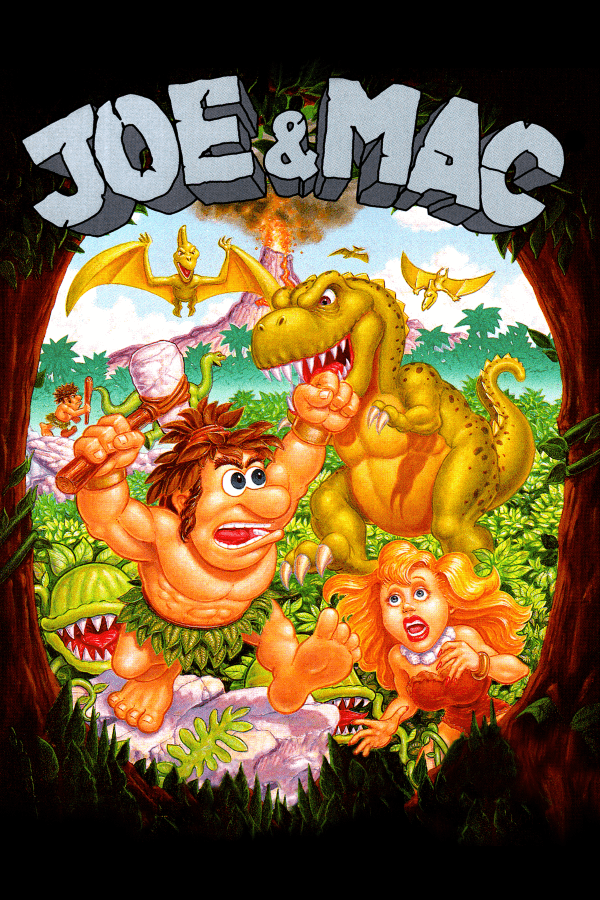

In Joe & Mac: Caveman Ninja, keeping your green or blue hair styled is easy, but keeping your stomach full while dodging a giant Tyrannosaurus Rex takes actual work.
Arcade platformers in the early nineties usually suffered when translated to home computers, losing frames of animation or sacrificing color depth to fit on standard floppies. Data East built a hit in the arcades with two club-wielding heroes, and bringing that level of visual punch to DOS hardware required careful optimization. Published in North America by New World Computing, the game arrived on standard PC displays carrying a surprising amount of the original cabinet's personality.
The core setup is straightforward platforming action. Playing solo or alongside a friend in two-player co-op, you take control of Joe or Mac to track down a tribe of Neanderthals who ran off with your village's women. You jump across platforms, bash enemy tribesmen with stone weapons, and push through six stages packed with prehistoric hazards. It is a formula that relies entirely on momentum, quick reflexes, and knowing when to throw a stone wheel instead of swinging a basic club.
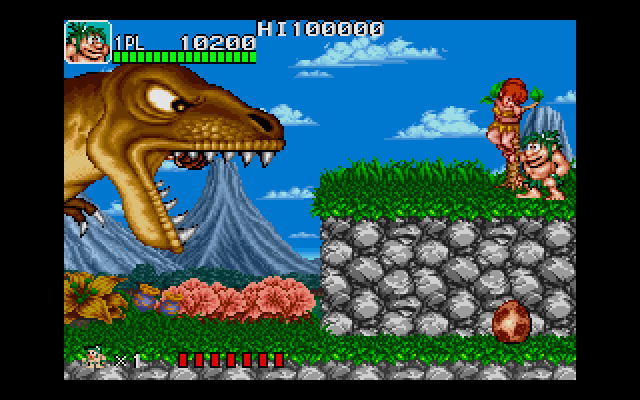
The combat in Joe & Mac: Caveman Ninja is built around a distinct risk-reward system for your attacks. Beyond standard throws, holding down the attack button makes your character swing his arm in a full circle, charging up a massive version of your current weapon. If you hold the button for too long, however, your character gets dizzy and temporarily stops moving, leaving you completely vulnerable. The arsenal goes well beyond simple rocks, letting you crack open pterodactyl eggs to grab boomerangs, bones, fire, flints, electricity, stone wheels, or even shadow-clone doppelgangers that charge across the screen.
The major mechanical twist, and the thing that frustrates most new players, is the health bar. Your life meter continuously drains over time simply due to hunger, regardless of whether you take hit points from enemies or hazards. To stay alive, you have to constantly hunt down food drops like fruit while maintaining a forward sprint through the stage. The design forces a strict, aggressive pace that prevents you from playing defensively or hanging back to learn enemy patterns.
Technically, the conversion to 1991 hardware is impressive for a 256-color VGA release. Running at 256x180 resolution, the engine manages multiple layers of parallax scrolling and giant boss sprites while keeping memory requirements to a modest 512K of conventional RAM and 288K of EMS memory. The tradeoff for matching the bright colors of the arcade shows up in the sound output. If you played it on a standard 8-bit Sound Blaster or AdLib card, the music and sound effects come across as noticeably thinner than the arcade original, though pairing the system with a Roland MT-32 card restores the full MIDI score.

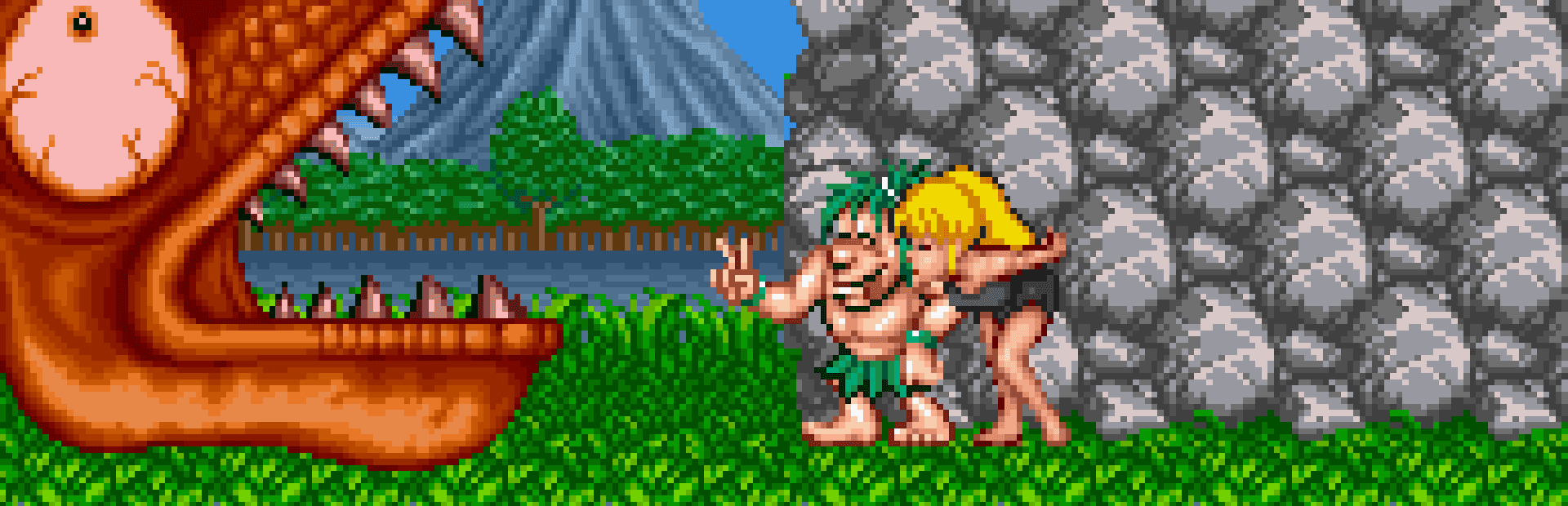
The journey takes you through jungles, rushing rivers, vertical cliffs, active volcanoes, mammoth caves, and a massive dinosaur graveyard. Joe & Mac: Caveman Ninja offers level branching after specific boss encounters, letting you choose your path toward the final confrontation. The last battle takes place inside the stomach of a giant red T-Rex, and once the beast is defeated, you are presented with three different exit doors that lead to three distinct ending cutscenes.
What holds up best today is the responsive character movement and the variety in stage design, while the constant health drain is still an acquired taste that punishes hesitation. Few DOS side-scrollers from that year managed to feel this complete. You can play Joe & Mac: Caveman Ninja online free in your browser right now, with no setup required. Grab a controller or set your keys, charge up a throw without making your caveman pass out, and see if you can make it all the way to the dinosaur graveyard on your first credit.
In Joe & Mac: Caveman Ninja, keeping your green or blue hair styled is easy, but keeping your stomach full while dodging a giant Tyrannosaurus Rex takes actual work.
Arcade platformers in the early nineties usually suffered when translated to home computers, losing frames of animation or sacrificing color depth to fit on standard floppies. Data East built a hit in the arcades with two club-wielding heroes, and bringing that level of visual punch to DOS hardware required careful optimization. Published in North America by New World Computing, the game arrived on standard PC displays carrying a surprising amount of the original cabinet's personality.
The core setup is straightforward platforming action. Playing solo or alongside a friend in two-player co-op, you take control of Joe or Mac to track down a tribe of Neanderthals who ran off with your village's women. You jump across platforms, bash enemy tribesmen with stone weapons, and push through six stages packed with prehistoric hazards. It is a formula that relies entirely on momentum, quick reflexes, and knowing when to throw a stone wheel instead of swinging a basic club.

The combat in Joe & Mac: Caveman Ninja is built around a distinct risk-reward system for your attacks. Beyond standard throws, holding down the attack button makes your character swing his arm in a full circle, charging up a massive version of your current weapon. If you hold the button for too long, however, your character gets dizzy and temporarily stops moving, leaving you completely vulnerable. The arsenal goes well beyond simple rocks, letting you crack open pterodactyl eggs to grab boomerangs, bones, fire, flints, electricity, stone wheels, or even shadow-clone doppelgangers that charge across the screen.
The major mechanical twist, and the thing that frustrates most new players, is the health bar. Your life meter continuously drains over time simply due to hunger, regardless of whether you take hit points from enemies or hazards. To stay alive, you have to constantly hunt down food drops like fruit while maintaining a forward sprint through the stage. The design forces a strict, aggressive pace that prevents you from playing defensively or hanging back to learn enemy patterns.
Technically, the conversion to 1991 hardware is impressive for a 256-color VGA release. Running at 256x180 resolution, the engine manages multiple layers of parallax scrolling and giant boss sprites while keeping memory requirements to a modest 512K of conventional RAM and 288K of EMS memory. The tradeoff for matching the bright colors of the arcade shows up in the sound output. If you played it on a standard 8-bit Sound Blaster or AdLib card, the music and sound effects come across as noticeably thinner than the arcade original, though pairing the system with a Roland MT-32 card restores the full MIDI score.

The journey takes you through jungles, rushing rivers, vertical cliffs, active volcanoes, mammoth caves, and a massive dinosaur graveyard. Joe & Mac: Caveman Ninja offers level branching after specific boss encounters, letting you choose your path toward the final confrontation. The last battle takes place inside the stomach of a giant red T-Rex, and once the beast is defeated, you are presented with three different exit doors that lead to three distinct ending cutscenes.
What holds up best today is the responsive character movement and the variety in stage design, while the constant health drain is still an acquired taste that punishes hesitation. Few DOS side-scrollers from that year managed to feel this complete. You can play Joe & Mac: Caveman Ninja online free in your browser right now, with no setup required. Grab a controller or set your keys, charge up a throw without making your caveman pass out, and see if you can make it all the way to the dinosaur graveyard on your first credit.
The on-screen keyboard and gamepad mapping the browser player uses on a phone, a tablet or a controller, as opposed to the real keys above. $PRO members make their own in the player and share them here; anyone can pick one to play with.
Cheat codes, console commands and memory pokes for Joe & Mac: Caveman Ninja — each one verified and attributed.
Sign in to submitaka Caveman Ninja · Caveman Ninja: Joe & Mac · Joe & Mac
The on-screen keyboard and gamepad mapping the browser player uses on a phone, a tablet or a controller, as opposed to the real keys above. $PRO members make their own in the player and share them here; anyone can pick one to play with.
Cheat codes, console commands and memory pokes for Joe & Mac: Caveman Ninja — each one verified and attributed.
Sign in to submit