

In Fantasy General, an army of knights, mechanical cannons, and giant eagles collides on hex grids where one bad tactical choice leaves your veterans dead and your campaign ruined.
Panzer General trades historical armor for dragons and plague engines
When Strategic Simulations, Inc. took the proven engine behind their hit World War II wargame and applied it to high fantasy in 1996, the result was far more than a simple reskin. Developed by the SSI Special Projects Group and published by Mindscape, Inc., Fantasy General retains the turn-based hex mechanics of its predecessor while introducing spellcasting, morale shifts, and wildly diverse unit archetypes. The core loop demands constant forward momentum, forcing you to balance territorial control with strict turn limits that punish defensive play.
Before stepping onto the operational map, you choose one of four commanders: Knight Marshall Calis, Lord Marcas, Archmage Krell, or Sorceress Mordra. This choice fundamentally alters your logistical strategy. Calis makes cavalry recruits significantly cheaper and grants a global heal spell once per engagement, while Marcas boosts starting experience and unit recruitment rates. Krell and Mordra tilt the battlefield toward raw magical force, allowing you to rain destruction across enemy lines before your front rank even makes contact.
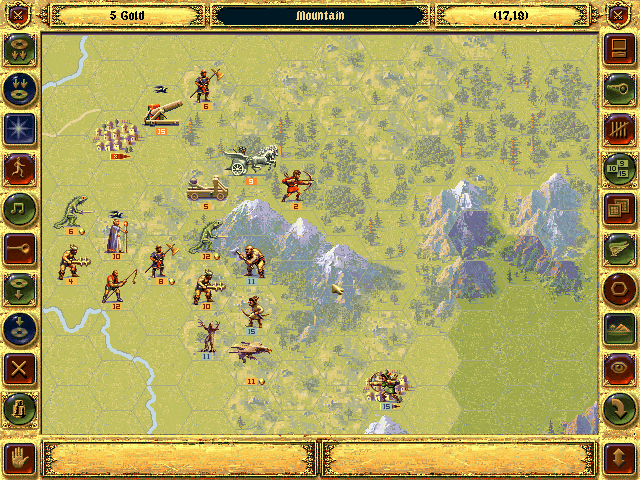
Terrain, budget management, and the brutal weight of turn limits in Fantasy General
The campaign spans five distinct landmasses across the fantasy world of Aer, beginning in the desolate waste of Keldonia, moving through the Isle of Four Winds and Avernion, and finishing with a final assault on Fire Isle. Victory requires total control of supply lines and terrain advantages. Heavy cavalry dominates open plains but breaks entirely when forced into swamps, while siege engines hurling plague germs can soften up fortified positions from three hexes away if you keep them protected from flying beasts.
Every scenario tests your long-term army growth rather than just tactical survival. Gold earned from victory feeds directly into unit upgrades, new recruitment, and magic research, meaning every loss is a permanent drain on your war chest. You spend your turns balancing aggressive pushes with careful exploration, uncovering hidden shrines, caches of gold, and joinable special heroes tucked away in fog-covered corners of the map.
The central mechanics break down into several interlocking systems that dictate victory on every field:
- Terrain Impact: Swamps, mountains, and dense woods alter movement speed, attack efficiency, and defensive cover for light, heavy, and mechanical ground units.
- Experience and Upgrades: Surviving units accumulate battle experience, raising their base stats and allowing you to convert them into higher-tier regiments as research unfolds.
- Spellcasting Powers: Heroes and specialized magical units drop offensive bolts, morale boosts, or area-of-effect curses directly onto enemy formations.
- Strict Turn Limits: Scenarios enforce tight turn counters, forcing you to advance aggressively rather than sitting back to heal damaged troops.
Unforgiving difficulty and manual errors that kept players stuck
While mainstream outlets like Computer Gaming World praised the title as an accessible take on operational wargaming, other reviewers and long-time fans quickly highlighted its sheer hostility. GameSpot panned the game for its abstract realism and gloomy audio, while PC Gamer noted friction in how historical wargame concepts were mapped to magic units. The late-game AI receives absurd resource advantages, frequently spamming multiple high-tier spells every turn while your surviving units sit trapped in villages, forced to spend precious turns resting and reinforcing.
This design creates severe difficulty spikes that turn late campaigns into exercises in trial-and-error. Because a single bad battle can permanently bankrupt your army, save scumming before capturing shrines or committing to major choke points became standard operating procedure. Compounding the confusion, the original printed documentation was notorious for containing stat errors and visual discrepancies, meaning the actual performance of your units rarely matched what the manual promised.
A staggering presentation backed by classic Redbook audio
The visuals and sound design carry most of the weight. Running in 640x480 SVGA, the unit sprites look like hand-painted tabletop miniatures set across expansive terrain. Composers Danny Pelfrey and Rick Rhodes provided a Redbook CD audio soundtrack packed with orchestral tracks and classical choral chants. Hearing liturgical vocals thunder through a Sound Blaster 16 board while giant eagles smash into skeleton archers gave the game a mood few strategy titles could match in 1996.
Beyond the main campaign, the inclusion of an "Arena" mode added massive replayability, letting players draft armies under Good or Evil alignments for custom skirmishes. It even included hotseat and Play-By-Mail functionality, allowing human opponents to fight out tactical scenarios turn by turn long before smooth online matchmaking existed.
How to play Fantasy General free in your browser today
If you want to experience a classic MS-DOS game that tests your tactical discipline, you can play Fantasy General online free in your browser right now. It requires no installation or complex setup, letting you jump straight into the opening scenarios of Keldonia within seconds.
When you start your first campaign, pick Knight Marshall Calis for his army-wide healing ability and discount on heavy cavalry, which gives you room to make tactical mistakes while learning terrain modifiers. Keep your archers parked directly behind your foot soldiers, clear out enemy scouts before pushing into the fog of war, and pay close attention to the turn counter so you do not get caught short on victory conditions.