Action-heavy dogfighting always mattered more than authentic cockpit drill in F-15 Strike Eagle II, a sim that traded tedious flight checks for immediate air combat. The 1992 Deluxe Edition brought together the 1989 base game and the Operation Desert Storm expansion, giving virtual pilots six massive combat theaters and a strike fighter that handled more like an arcade starfighter than an exercise in aviation math.
Purists who wanted to spend twenty minutes reviewing pre-flight checklists and calculating fuel burn rates were routinely appalled by this game. MicroProse built a combat flight simulation designed for speed, fast dogfighting, and immediate tactical payoffs. You climb straight into the cockpit, spool up the engines, and target enemy bogeys within seconds of clearing the runway.
Every mission gives you a straightforward primary and secondary target. You might be sent to bomb a satellite tracking station deep behind enemy lines or wipe out a missile boat cruising the coast, but the skies between your base and the objective are always crawling with hostile interceptors. To make your life easier, taking out an enemy airfield early in a mission actually stops them from scrambling extra fighters into your airspace, a detail that turned tactical bombing into genuine self-defense.
Your fighter comes loaded with a deadly assortment of military hardware:
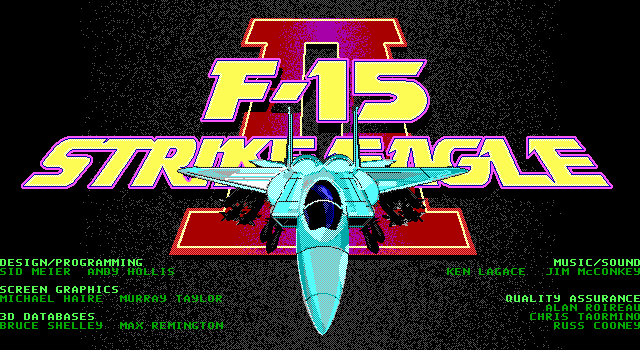
Designers Andy Hollis and Sid Meier built this title at MPS Labs using the solid 3D polygon graphics engine originally developed for MicroProse's earlier hit, F-19 Stealth Fighter. While F-19 focused on high-stakes stealth, radar evasion, and carefully planning your flight path around overlap coverage, this arcade-leaning spin-off pushed that same rendering technology into pure action territory. The MS-DOS release ran smoothly on hardware that stumbled over heavier flight models, which made it a massive hit for players running modest 286 or 386 setups.
The 1992 Deluxe Edition compiled the original base release alongside the Operation Desert Storm Scenario Disk while pulling in the North Cape and Central Europe combat theaters straight from F-19. That created a massive package spanning Libya, the Persian Gulf, Vietnam, the Middle East, and European battlegrounds. MicroProse Software, Inc. catered directly to casual desk pilots by providing extensive difficulty toggles: you could disable crash damage entirely or let the flight computer handle take-offs and landings while you focused on missile locks.
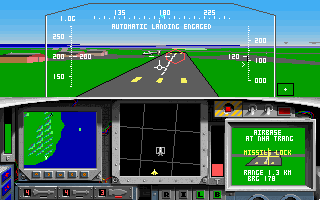
If you look at modern screenshots, the visual compromises are obvious. The terrain consists of flat, blocky polygons, ground targets are composed of simple geometric prisms, and enemy jets can look a bit like advanced paper airplanes when viewed up close. Retrospective critics who judge the package solely on visual fidelity often hit it with brutal scores for its lack of detail.
Yet in 1992, these flat-shaded shapes allowed for genuine multi-object dogfights without tanking your frame rate. What really sold the presentation was the brilliant addition of two cutaway "Director's Modes." Whenever something dramatic happened, the game temporarily cut away from your main cockpit HUD to show external dramatic views:
You would suddenly see a cinematic shot of an enemy base scrambling fighters, a ground-based SAM launcher tracking your jet, or a Maverick missile slamming directly into a target airfield. On the audio side, while the standard PC speaker rattled out grating engine hums, sound cards like the AdLib and Roland CM-32L delivered surprisingly punchy weapon fires and score stings.
While the game starts out forgiving, higher difficulty settings introduce sharp frustration spikes. As you climb the ranks, hostile AI accuracy shoots through the roof, enemy warplanes inflict devastating damage, and precise fuel management becomes a matter of life and death. If you get careless with the afterburners while chasing a MIG, you will find yourself gliding home on empty long before you reach friendly territory.
The most infuriating flaw involves surface-to-air missile batteries. Ground-based SAM sites frequently launch radar-guided missiles at your jet from far beyond your visual horizon, long before the target structures even render on screen. You end up relying entirely on radar warnings and flaring wildly while trying to dodge invisible threats rising out of empty terrain. If you want to dive deeper into this classic era of target tracking and radar management, exploring the broader library of simulation games shows just how quickly flight mechanics evolved throughout 1992.
Even with primitive visuals, this compile captures a specific moment when PC flight simulators balanced tactical combat with pure action better than almost anything else on the market. It drops you straight into the thick of combat without forcing you to memorize a massive ring-bound manual first.
You can play F-15 Strike Eagle II online right here in your browser, entirely free. Load up the Persian Gulf campaign, switch on the Director's Mode camera, and fire off an AMRAAM missile at a distant radar target just to watch the cinematic external camera follow your ordinance all the way to impact.
Action-heavy dogfighting always mattered more than authentic cockpit drill in F-15 Strike Eagle II, a sim that traded tedious flight checks for immediate air combat. The 1992 Deluxe Edition brought together the 1989 base game and the Operation Desert Storm expansion, giving virtual pilots six massive combat theaters and a strike fighter that handled more like an arcade starfighter than an exercise in aviation math.
Purists who wanted to spend twenty minutes reviewing pre-flight checklists and calculating fuel burn rates were routinely appalled by this game. MicroProse built a combat flight simulation designed for speed, fast dogfighting, and immediate tactical payoffs. You climb straight into the cockpit, spool up the engines, and target enemy bogeys within seconds of clearing the runway.
Every mission gives you a straightforward primary and secondary target. You might be sent to bomb a satellite tracking station deep behind enemy lines or wipe out a missile boat cruising the coast, but the skies between your base and the objective are always crawling with hostile interceptors. To make your life easier, taking out an enemy airfield early in a mission actually stops them from scrambling extra fighters into your airspace, a detail that turned tactical bombing into genuine self-defense.
Your fighter comes loaded with a deadly assortment of military hardware:
Designers Andy Hollis and Sid Meier built this title at MPS Labs using the solid 3D polygon graphics engine originally developed for MicroProse's earlier hit, F-19 Stealth Fighter. While F-19 focused on high-stakes stealth, radar evasion, and carefully planning your flight path around overlap coverage, this arcade-leaning spin-off pushed that same rendering technology into pure action territory. The MS-DOS release ran smoothly on hardware that stumbled over heavier flight models, which made it a massive hit for players running modest 286 or 386 setups.
The 1992 Deluxe Edition compiled the original base release alongside the Operation Desert Storm Scenario Disk while pulling in the North Cape and Central Europe combat theaters straight from F-19. That created a massive package spanning Libya, the Persian Gulf, Vietnam, the Middle East, and European battlegrounds. MicroProse Software, Inc. catered directly to casual desk pilots by providing extensive difficulty toggles: you could disable crash damage entirely or let the flight computer handle take-offs and landings while you focused on missile locks.
If you look at modern screenshots, the visual compromises are obvious. The terrain consists of flat, blocky polygons, ground targets are composed of simple geometric prisms, and enemy jets can look a bit like advanced paper airplanes when viewed up close. Retrospective critics who judge the package solely on visual fidelity often hit it with brutal scores for its lack of detail.
Yet in 1992, these flat-shaded shapes allowed for genuine multi-object dogfights without tanking your frame rate. What really sold the presentation was the brilliant addition of two cutaway "Director's Modes." Whenever something dramatic happened, the game temporarily cut away from your main cockpit HUD to show external dramatic views:
You would suddenly see a cinematic shot of an enemy base scrambling fighters, a ground-based SAM launcher tracking your jet, or a Maverick missile slamming directly into a target airfield. On the audio side, while the standard PC speaker rattled out grating engine hums, sound cards like the AdLib and Roland CM-32L delivered surprisingly punchy weapon fires and score stings.
While the game starts out forgiving, higher difficulty settings introduce sharp frustration spikes. As you climb the ranks, hostile AI accuracy shoots through the roof, enemy warplanes inflict devastating damage, and precise fuel management becomes a matter of life and death. If you get careless with the afterburners while chasing a MIG, you will find yourself gliding home on empty long before you reach friendly territory.
The most infuriating flaw involves surface-to-air missile batteries. Ground-based SAM sites frequently launch radar-guided missiles at your jet from far beyond your visual horizon, long before the target structures even render on screen. You end up relying entirely on radar warnings and flaring wildly while trying to dodge invisible threats rising out of empty terrain. If you want to dive deeper into this classic era of target tracking and radar management, exploring the broader library of simulation games shows just how quickly flight mechanics evolved throughout 1992.
Even with primitive visuals, this compile captures a specific moment when PC flight simulators balanced tactical combat with pure action better than almost anything else on the market. It drops you straight into the thick of combat without forcing you to memorize a massive ring-bound manual first.
You can play F-15 Strike Eagle II online right here in your browser, entirely free. Load up the Persian Gulf campaign, switch on the Director's Mode camera, and fire off an AMRAAM missile at a distant radar target just to watch the cinematic external camera follow your ordinance all the way to impact.
aka F-15 Strike Eagle II Plus
How F-15 Strike Eagle II (Deluxe Edition) is played — the keys the game listens to, grouped by what they do.
Highlighted keys are mapped — hover or tap one to see what it does.
Pilot name entry during roster creation and security authentication requires text typing. Calibration for joysticks can be done in-flight using Alt+J.
The on-screen keyboard and gamepad mapping the browser player uses on a phone, a tablet or a controller, as opposed to the real keys above. $PRO members make their own in the player and share them here; anyone can pick one to play with.
Cheat codes, console commands and memory pokes for F-15 Strike Eagle II (Deluxe Edition) — each one verified and attributed.
Sign in to submitHow F-15 Strike Eagle II (Deluxe Edition) is played — the keys the game listens to, grouped by what they do.
Highlighted keys are mapped — hover or tap one to see what it does.
Pilot name entry during roster creation and security authentication requires text typing. Calibration for joysticks can be done in-flight using Alt+J.
The on-screen keyboard and gamepad mapping the browser player uses on a phone, a tablet or a controller, as opposed to the real keys above. $PRO members make their own in the player and share them here; anyone can pick one to play with.
Cheat codes, console commands and memory pokes for F-15 Strike Eagle II (Deluxe Edition) — each one verified and attributed.
Sign in to submit