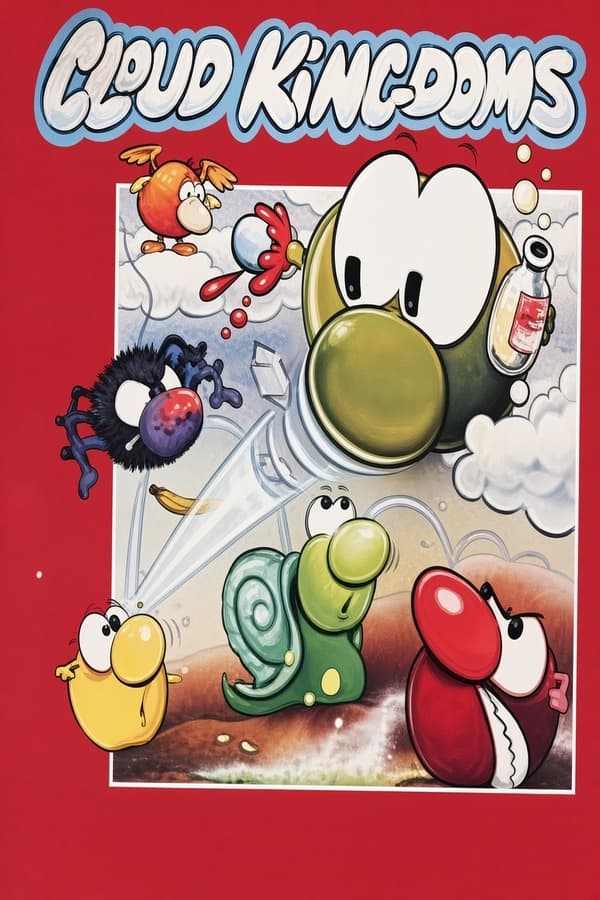
Cloud Kingdoms
Rate this game
- Played
- Rarely
In Cloud Kingdoms, you roll a green sphere named Terry across floating islands where a single bad bounce sends you plummeting into the open sky.
Mastering tile physics and momentum in Cloud Kingdoms
Every level gives you a top-down view of a grid suspended in mid-air. You guide Terry, an eight-way rolling sphere with big eyes, through layout after layout of traps to recover his stolen crystals from Baron von Bonsai. There are no lasers or power swords here. Your only native defense is a jump button that lets you hop over roaming black balls and transformed fairy insects.
The grid tiles are where the true fight happens. Stepping onto an Arrow Kingdom square forces Terry sideways or backward against your will. Ice Kingdom tiles strip away your friction, sending you sliding helpless toward the perimeter. Magnet tiles freeze your spring entirely, meaning any enemy patrolling near them must be outmaneuvered rather than leaped over.
The layout designs demand extreme spatial discipline. In Box Kingdom, you spend half your time flying across trapped squares to grab keys before jumping onto isolated platforms. In Unseen Kingdom, the floor itself vanishes, leaving only visible drop-offs to guide your memory. If you oversteer on an early turn, the momentum carries you straight into the abyss.
Branching maps and the 400-second ticking clock
Instead of giving you a standard pool of lives, the game forces you to manage a shared global time bank. You begin your quest with roughly four hundred seconds on the main clock. Every mistake costs precious seconds, and falling into a pit or touching a roaming creature forces a full level restart.
Clearing a stage adds eighty seconds back into your reserves. That mechanic creates a constant calculation between speed and caution. Move too slowly to avoid edge slips, and the overall clock drains to zero. Rush through a tight key puzzle, and a bad jump resets the entire floor layout while burning away your buffer.
You do not play all thirty-two sky islands in a single run. The campaign uses a branching non-linear map where you complete eight stages total to reach the end. Your initial choice splits between four starting stages, with subsequent choices narrowing down to three, two, and finally prescribed end stages based on your chosen path.
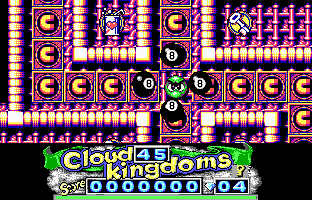
From C64 roots to CGA and EGA PC displays
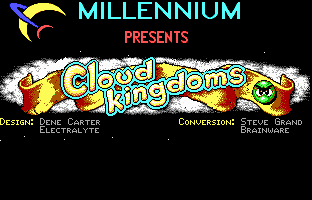
Designed and coded originally on the Commodore 64 by Dene Carter, this top-down action game moved to PC hardware through programmer Stephen Grand at Brainware. Publisher Millennium Interactive Ltd. brought it to store shelves in 1990 alongside Atari ST and Amiga ports.
Artist Paul Docherty adapted the visual presentation to support four-color CGA and sixteen-color EGA monitors. On a standard PC monitor of the era, the sharp EGA tiles clearly showed direction arrows and key positions, even if the PC speaker lost the audio atmosphere created by David Whittaker on rival home computers.
When contemporary magazine reviewers opened their boxed copies, opinion split down the middle. Datormagazin awarded early releases 5/10 scores, praising the central marble movement while pointing out the steep asking price of £24.99 for a title with only eight playable levels per successful run. British magazines like Zzap!64 famously tracked the ticking global clock under the custom time unit "Manukas".
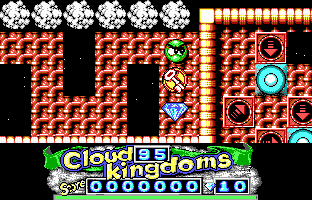
The brutal precision required to clear all eight stages
What modern players discover within two minutes is that falling off the edge is not an occasional mistake; it is the core loop. Retro gaming communities frequently refer to Terry by the informal nickname "Plop" precisely because of the constant sound and frequency of plunging off the stage. You will fall off an edge at least once every five minutes until you memorize the floor layouts.
Random item drops offer brief relief. Bonus fruits, time extensions, and temporary power-ups occasionally appear on open grid squares. However, reaching a surprise time pickup sitting on the edge of an ice tile often causes the exact over-correction that ruins your entire run.
Without mid-game saves or level passwords, reaching the final stages requires complete memorization of all eight selected worlds. The sliding inertia on the ice worlds grates fast, but landing a long leap across invisible floor gaps to snatch the final key feels genuinely earned.
The full weight of the global timer and those slippery EGA floor tiles can be tested right now. You can play Cloud Kingdoms online, free in your browser, with no setup or downloads required. Once you load the MS-DOS game, try taking the western path on the world map first to see how your momentum holds up on the arrow tiles before attempting the invisible bridges.
How Cloud Kingdoms is played — the keys the game listens to, grouped by what they do.
- Interface
Highlighted keys are mapped — hover or tap one to see what it does.
The manual states PC players can define their keyboard controls if they do not own a joystick; default movement and action keys are not specified in the source.
Players' controls
Touch and gamepad controls
The on-screen keyboard and gamepad mapping the browser player uses on a phone, a tablet or a controller, as opposed to the real keys above. $PRO members make their own in the player and share them here; anyone can pick one to play with.
Make your own touch controlsPRO
- 1Open the editorSign in below, then pick what to make. The game starts with the editor open over it.
- 2Place your keysAdd keys and drag them where your thumbs rest, or map a controller's buttons. Test plays the game with them; Save keeps them, and you play with them from then on.
- 3Share themShare them right after saving in the game, or name and share them here. Players vote, and the best become this game's controls for everyone.
Go PROSee how it worksSign in+20 XP for sharing · +50 XP if yours become the game's own
- The game's own controlsNone yet: played with a real keyboard only.In use
3 screenshots
From the archive
No gameplay video yet
No gameplay video for Cloud Kingdoms yet. Sign in to add one.
No reviews yet
Tell the community what you think of Cloud Kingdoms. Reviews are public and tied to your username.
No archived manuals for Cloud Kingdoms yet
No manuals archived for this title yet. Sign in to upload the first scan.
Cheat codes, console commands and memory pokes for Cloud Kingdoms — each one verified and attributed.
Sign in to submitNo cheats yet for this title
Know a working cheat, poke or trainer? Add it with the button above. Moderators check every entry before it goes live.
No archived soundtrack for Cloud Kingdoms yet
No soundtrack archived for this title yet. Sign in to upload the first rip.
No save states for Cloud Kingdoms yet
No save states for this title yet. Sign in to share one.
Discussions
Sign in to post- Threads0
- Total posts0
- Online now6
Community · Cloud Kingdoms
Who's contributing, and what's new
- Reviews0
- Threads0
- Uploadsapproved0
- Contributors0
Recent activity
Nothing here yet
Reviews, discussion threads and approved uploads appear here as members add them.